← The libraryTopic collection / 7 explainers
Genetics
Understand genome editing, genetic variation, RNA measurements and the reference maps that make sequence data meaningful.
Articles in this topic

Base editors change DNA chemistry within a targeting window; prime editors copy a proposed edit from an RNA template. Their different strengths do not remove delivery or safety constraints.
Read the explainer ↗
A programmable DNA editor can change a cell. Turning that change into a treatment also requires a sound biological target, effective delivery and evidence that patients benefit.
Read the explainer ↗
Chemical marks help cells use the same DNA in different ways. That real biology does not make every exposure-associated mark a cause of disease, or every lifestyle claim a proven way to rewrite inheritance.
Read the explainer ↗
A laboratory can identify a DNA difference without knowing its clinical meaning. Reading the report well means separating detection, classification, personal risk and the limits of the test.
Read the explainer ↗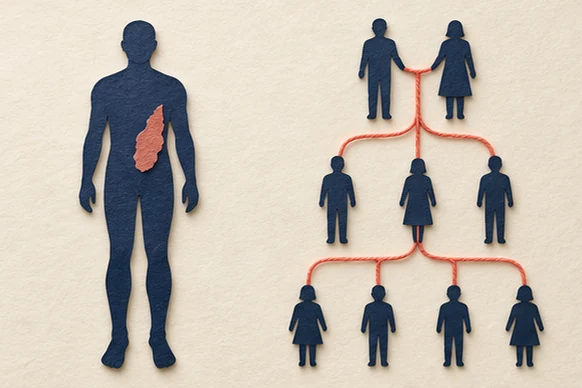
The central difference is not whether an edit is powerful or permanent. It is which cells change, whether the change could be inherited and who bears the consequences.
Read the explainer ↗
RNA-seq samples molecules present in a specimen, then uses a laboratory and computational pipeline to estimate their abundance. It is not a direct meter of protein activity or a complete record of gene regulation.
Read the explainer ↗
A reference provides shared coordinates for comparing DNA. It is neither a biologically ideal genome nor a complete representation of human variation, which is why reference design affects what researchers can see.
Read the explainer ↗