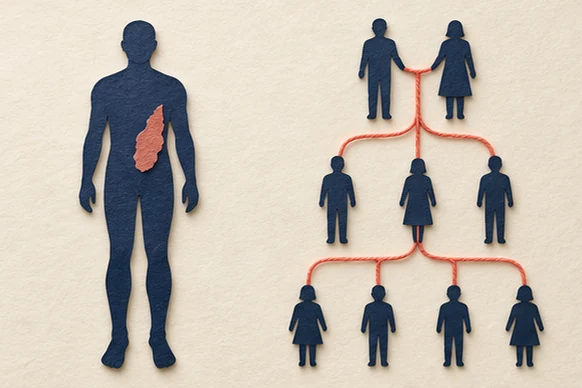
- A somatic edit can persist within a person without being inherited by their children.
- Research involving reproductive cells is not the same act as using an edited embryo to establish a pregnancy.
- Both categories need oversight, but heritable editing adds consequences for future people and generations.
Inheritance is the dividing line
Somatic cells are the body's non-reproductive cells. Editing them aims to affect the person receiving the intervention, not to alter the genetic material they pass to children. Germline editing concerns reproductive cells or their precursors and, depending on the context, early embryos whose descendants could include reproductive cells. An edit can become heritable if it enters the reproductive lineage and is passed on. [1]
This distinction is easy to lose when headlines call any lasting DNA change 'inherited.' Cells within one person's body can copy an edit when they divide. That is cellular inheritance, not necessarily inheritance from parent to child. An edited blood stem cell can generate many edited blood cells without changing the DNA in that person's eggs or sperm. Permanence and reproductive transmission are different questions.
Somatic does not mean temporary or minor
The therapeutic objective may be a long-lived effect in a somatic cell population. Blood stem cells are a clear example because they can sustain production of descendant blood cells. In the FDA's original Casgevy account, patients' own edited stem cells engraft in bone marrow and increase fetal hemoglobin production. This illustrates substantial biological change within an individual without a reproductive editing objective. [3]
Nor does the somatic label mean harmless. Delivery, unintended molecular changes, the behavior of modified cells and the surrounding clinical procedure still matter. The same FDA account describes chemotherapy conditioning and long-term follow-up. Calling an intervention somatic identifies the intended inheritance boundary; it does not answer whether a particular patient is likely to benefit or whether the intervention's total risks are acceptable. [3]
Research and reproductive use are different decisions
An experiment on reproductive cells or embryos can investigate development or editing accuracy without being used to establish a pregnancy. Reproductive use takes a further step: an edited embryo or reproductive cell contributes to a person, potentially connecting an experimental change to later generations. Treating these activities as identical obscures the different decisions, oversight requirements and consequences involved.
WHO's governance work explicitly addresses somatic, germline and heritable editing. Its recommendations cover institutional, national and international oversight, research registries, unsafe or unregistered activity and public engagement. This is a broader task than deciding whether an editing enzyme works. It includes how research is conducted, how it is disclosed and how health systems respond when scientific activity crosses borders. [2]
A change can have uneven biological reach
In a somatic treatment, changing every cell in the body is often unnecessary. The question is whether enough of a relevant population changes to produce the intended effect. In reproductive use, the distribution of an edit raises different questions. If editing occurs unevenly during early development, different cell lineages may carry different sequences. A sample from one location cannot automatically establish the sequence in all future tissues.
This illustrates a general measurement problem rather than a reason to label all editing equally risky. A test describes the material actually sampled, using an assay with particular limits. Claims about an entire developing organism or future reproductive cells require more than a favorable result in a small sample. Evidence sufficient to characterize a controlled laboratory experiment may be insufficient to justify a consequential reproductive decision.
Consent and benefit operate on different timescales
For somatic editing, an eligible adult can consider the intended benefit, known harms, alternatives and remaining uncertainty with clinicians. Children and people unable to consent require additional protections, as in other medical research. Even with valid consent, scientific uncertainty remains. Consent authorizes participation within an ethical framework; it does not transform an inadequately tested intervention into a sound one.
Heritable editing adds people who cannot participate in the original decision. Future descendants could receive the change while living in different environments or having different genetic backgrounds. Parents routinely make consequential choices for children, so inability to obtain future consent is not a complete ethical argument by itself. The relevant discussion also concerns necessity, proportionality, avoidable risks, public accountability and whether benefits could be achieved without making a change heritable. [1][2]
Do not confuse an ethical category with a policy verdict
A hypothetical intervention intended to prevent a severe single-gene disorder raises different benefit questions from an attempt to influence a complex trait such as height. Complex traits involve many variants and environmental influences, so a biologically plausible association is not a dependable instruction for improvement. NHGRI emphasizes both the multiple functions of genes and the difficulty of predicting consequences in complex disease. [1]
A useful discussion therefore asks which cells are edited, whether reproductive transmission is possible, what evidence supports the intended benefit and who has authority to decide. It also asks who might be excluded from benefits or exposed to pressure to use the technology. The somatic–germline distinction organizes these questions; it does not replace careful scientific evaluation or settle every issue of fairness and governance.
What this does not establish
This is a conceptual and ethical explainer, not a country-by-country legal guide. NHGRI’s older policy material is used for inheritance and biological principles, not its outdated clinical-status statements. The inspected WHO publication overview supports the governance discussion; it is not a review of every recommendation or a claim that international law is uniform.
Sources & further reading
Source records for this public draft are listed below with their historical access dates. Source checking is not medical validation or completed human editorial review.
- How is Genome Editing Used? ↗
National Human Genome Research Institute (NHGRI) · Accessed 2026-09-11
Somatic versus germline inheritance, delivery barriers, and disease complexity; not current clinical status.
- Human genome editing: recommendations ↗
World Health Organization (WHO) · Accessed 2026-09-11
Governance across somatic, germline and heritable editing; oversight, registries, international collaboration and public engagement. Publication overview inspected, not full report.
- FDA Approves First Gene Therapies to Treat Patients with Sickle Cell Disease ↗
U.S. Food and Drug Administration (FDA) · Accessed 2026-09-11
Historical December 2023 approval, fetal hemoglobin mechanism, cell collection and conditioning, single-arm trial endpoint and follow-up.
Educational information only. Not medical or financial advice. Do not change treatment or investment decisions based on this draft.