- Reaching an organ, entering a cell and producing a useful effect are different achievements.
- The cargo format determines where it must go and how long its instructions should last.
- Delivery outside the body trades some targeting problems for manufacturing and transplantation demands.
Begin with what is actually being delivered
'Getting a gene into cells' can describe several different interventions. A DNA construct may supply instructions for a missing protein. Messenger RNA may provide temporary instructions without introducing a new DNA sequence. An editing system may arrive as RNA or protein and then alter DNA already inside the cell. These cargos have different destinations and different requirements for persistence. [1][2]
A carrier that performs well for one cargo is not automatically suitable for another. Size, chemical stability and the number of components all matter. The FDA distinguishes gene addition, gene inactivation, editing and patient-derived modified-cell products within the broader gene-therapy field. Delivery should be evaluated against the particular mechanism, not against an abstract goal of getting any genetic material inside any cell. [1]
The body is not an open pipe
After administration, cargo encounters biological fluids, membranes and clearance processes before it reaches its target. Unprotected RNA is vulnerable to degradation and does not freely cross cell membranes. Delivery formulations protect it and influence where it travels. Route also matters: depositing material near a tissue creates a different starting problem from sending it through the bloodstream to a distant site. [2]
Lipid nanoparticles are mixtures whose components affect stability, circulation and interactions with cells. Lipid chemistry can shift which organs and cell populations receive cargo. But an organ is not one uniform target. A signal in a liver sample could reflect delivery to different resident cell types, only some of which may be therapeutically useful. Tissue accumulation is an intermediate measurement, not proof of successful treatment.
Entering a cell is only another checkpoint
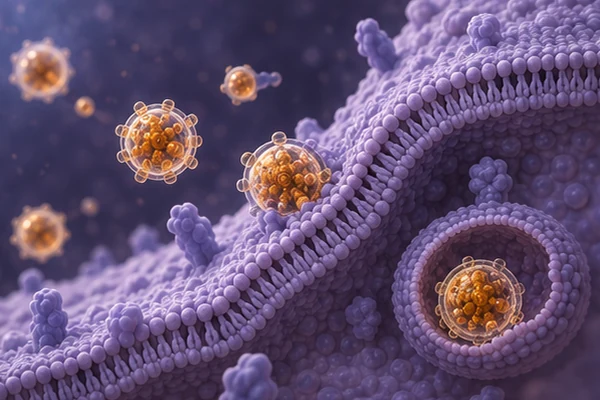
Cells can take up particles into membrane-bound compartments called endosomes. For an mRNA medicine, that is not the final destination: the RNA needs access to cytoplasmic translation machinery. Cargo that remains trapped can be degraded rather than translated. A bright image showing particles inside cells may therefore exaggerate functional delivery if it does not show that the message reached the right compartment. [2]
Ionizable lipids help address this problem. Their charge changes with acidity, and the more acidic environment inside endosomes can promote interactions that destabilize membranes and help release cargo. The details remain formulation-dependent; uptake and escape are not interchangeable quantities. Improving escape must also be balanced against tolerability, because a material designed to interact with membranes can have unwanted effects. [2]
Different vehicles impose different compromises
Modified viruses exploit biological machinery that is naturally good at transferring genetic material. The FDA describes viral vectors as vehicles engineered for therapeutic delivery rather than ordinary disease-causing viruses. That does not make every vector suitable for every tissue or cargo. Vehicle choice constrains what can be carried and how the resulting instructions behave in the recipient cell. [1]
Cargo capacity becomes especially visible with large editors. A prime editor includes a targeting protein and reverse transcriptase, plus guide RNA components. The reviewed literature describes compact and split designs intended to accommodate delivery limits. Requiring separate packages to reach the same cell introduces a coordination problem: detecting one component does not demonstrate that the complete functional editor was assembled there. [3]
Taking cells out changes the problem
Ex vivo delivery removes a selected cell population, modifies it under controlled conditions and returns a manufactured product. This can make exposure easier to control and allows testing before infusion. It does not mean every unwanted cell can be identified or that product testing eliminates long-term uncertainty. The modified cells must remain functional and survive the steps between collection and treatment. [1]
The FDA's original Casgevy announcement provides a concrete example: a patient's blood stem cells are collected, edited and transplanted back after high-dose chemotherapy conditioning. The cells must engraft in marrow to sustain blood-cell production. The delivery problem is therefore partly a transplantation problem, with its own risks and infrastructure requirements. A successful laboratory edit would not rescue a product that failed to engraft. [4]
Ask for a chain of functional evidence
Imagine a hypothetical formulation that produces abundant signal in a target organ. A persuasive evaluation would ask what the signal measures: carrier material, intact cargo, encoded protein or the intended DNA change. It would then ask which cells contain that signal, how long the effect persists and whether it improves the disease-relevant function. Each measurement tests a different link in the delivery chain.
A larger administered dose is not a universal solution to losses along that chain. More exposure may increase unwanted distribution or toxicity before enough useful cells are reached. Good delivery engineering tries to improve the fraction that completes the relevant journey, not merely the amount entering the body. The practical endpoint is enough useful activity in the right cells, for the needed duration, at an acceptable overall risk.
What this does not establish
This article explains delivery principles rather than ranking products or reporting current approval status. The lipid review includes preclinical and clinical examples that should not be treated as interchangeable evidence. Tissue distribution, durability, repeat dosing and immune effects require direct testing for each cargo, formulation, route and patient population.
Sources & further reading
Source records for this public draft are listed below with their historical access dates. Source checking is not medical validation or completed human editorial review.
- What is Gene Therapy? ↗
U.S. Food and Drug Administration (FDA) · Accessed 2026-09-11
Gene addition versus editing, viral vehicles, patient-derived modified cells and product-specific regulatory evaluation.
- Lipid nanoparticles for mRNA delivery ↗
Nature Reviews Materials · Accessed 2026-09-11
Lipid composition, ionizable lipids, tissue targeting, uptake versus endosomal escape, RNA sequence engineering and therapeutic research applications; not current trial status.
- Prime editing: therapeutic advances and mechanistic insights ↗
Gene Therapy · Accessed 2026-09-11
Nickase–reverse-transcriptase mechanism, pegRNA template, sequence scope, variable efficiency, unwanted products and delivery cargo-size constraints.
- FDA Approves First Gene Therapies to Treat Patients with Sickle Cell Disease ↗
U.S. Food and Drug Administration (FDA) · Accessed 2026-09-11
Historical December 2023 approval, fetal hemoglobin mechanism, cell collection and conditioning, single-arm trial endpoint and follow-up.
Educational information only. Not medical or financial advice. Do not change treatment or investment decisions based on this draft.