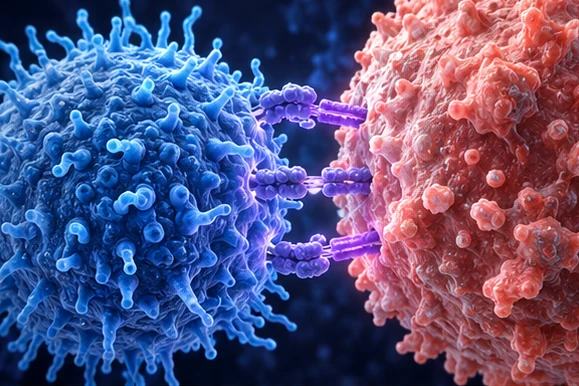
- A CAR redirects T-cell recognition toward a selected surface antigen, not toward cancer as an abstract category.
- The same immune activity that kills tumor cells can damage healthy tissue or trigger dangerous inflammation.
- Manufacturing success, initial response, and durable disease control are different milestones.
A new recognition system on an existing cell
T cells already possess machinery for detecting threats, communicating with other immune cells, and killing abnormal cells. CAR T-cell therapy changes how selected T cells recognize their targets. CAR stands for chimeric antigen receptor: an engineered receptor that connects recognition outside the cell to activation inside it. The goal is not to build an immune system from scratch, but to redirect a powerful part of the one a person already has. [1]
The distinction matters because a CAR recognizes a particular molecular feature, called an antigen, on a cell's surface. It does not independently determine whether that cell is malignant. If healthy cells carry the same accessible antigen, they can also be attacked. Target selection therefore includes two questions: how consistently is the antigen present on the cancer, and where else is it present?
The product begins with a person
In the patient-derived approach described by NCI, blood cells are collected and T cells are separated for genetic modification. The modified cells are grown to produce the treatment dose, tested, and returned for infusion. Patients may also receive treatment that reduces existing immune cells to help the transferred cells function. This preparative treatment has its own effects and should not disappear from an account of the therapy's benefits and burdens. [1][2]
The laboratory and clinic must remain coordinated throughout. NCI's manufacturing program describes shipping patient source material to a central facility and returning the tested, cryopreserved product to the appropriate clinical site. A bag of living cells is not interchangeable with another patient's bag. Correct identification, transport, and scheduling are part of making the biological idea into a usable treatment. [3]
Recognition can amplify itself
After infusion, CAR T cells can encounter antigen-bearing cells, become activated, and expand. Unlike a conventional drug whose administered molecules are progressively cleared, a living treatment can change its own abundance and activity after dosing. Persistence may help sustain surveillance against remaining cancer cells, but an infusion does not guarantee that the cells will expand, survive, or remain effective in every patient. [1]
Consider a hypothetical tumor containing both antigen-positive and antigen-negative cells. A treatment could remove many of the first group while leaving the second group relatively untouched. The tumor might initially shrink and later grow from the surviving population. This teaching example illustrates why a strong initial response does not establish permanent control, and why investigators explore receptors directed at more than one target.
The risk is partly in the mechanism
Activated immune cells release cytokines, signals that coordinate immune responses. An excessive response can produce cytokine release syndrome, or CRS, with fever, low blood pressure, and breathing problems. Severe cases can be life-threatening. NCI also describes neurologic toxicity, often grouped under immune effector cell-associated neurotoxicity syndrome, or ICANS. Confusion and impaired speech are among the possible signs. These complications require specialist monitoring and management, not interpretation as proof that treatment is working. [1][2]
A different problem is damage to normal cells sharing the target. Some CAR T-cell approaches can deplete normal antibody-producing B-cell populations, contributing to infection risk. Toxicity can thus arise from excessive immune communication, intended recognition occurring in an unwanted place, and the broader treatment course. Describing the therapy as targeted should never be taken to mean that it has no systemic consequences. [1]
Why a solid tumor is another environment
NCI describes established CAR T-cell treatment uses in several blood cancers, alongside ongoing research in solid tumors. Results cannot simply be transferred from one setting to the other. Solid tumors may contain regions with different antigen levels, physical obstacles to immune-cell entry, and local signals that suppress T-cell activity. A receptor can bind beautifully in a laboratory assay yet encounter too little accessible target inside a patient. [1]
Engineering additional receptors or modifying the cells to better withstand suppression may address individual barriers. Each modification also introduces questions about behavior, manufacturing consistency, and safety. A small early clinical trial can establish that an approach is feasible or produces a signal worth studying. It does not establish that all tumors of that type will respond, or that the balance of benefit and harm is favorable against existing treatment.
Read the outcome, not just the headline
A useful report separates successful manufacture, receipt of infusion, tumor response, response duration, survival, and adverse events. These are not synonyms. The denominator also matters: results among infused patients may not capture people who could not reach infusion. Comparisons across different cancers, treatment histories, or follow-up periods are especially vulnerable to misleading impressions. The central achievement is engineered recognition; the clinical question is whether that recognition improves a person's course of disease at an acceptable cost in risk.
What this does not establish
This is a mechanism-focused explanation, not an eligibility guide or an inventory of product labels. CAR designs, target antigens, preparative regimens, and monitoring needs vary. The cited NCI material supports the broad distinctions but cannot predict an individual's response or provide a single risk estimate for the entire class. Solid-tumor and donor-derived approaches discussed as research should not be assumed equivalent to established patient-derived treatments.
Sources & further reading
Source records for this public draft are listed below with their historical access dates. Source checking is not medical validation or completed human editorial review.
- CAR T Cells: Engineering Immune Cells to Treat Cancer ↗
National Cancer Institute · Accessed 2026-09-11
Patient-derived CAR T workflow, antigen recognition, living-drug expansion, CRS and ICANS, normal B-cell depletion, and solid-tumor barriers.
- T-cell Transfer Therapy - Immunotherapy ↗
National Cancer Institute · Accessed 2026-09-11
Cell collection and expansion, preparative immune-cell reduction, CRS, and recognition of healthy tissue.
- Production of Cell-based Therapies ↗
National Cancer Institute · Accessed 2026-09-11
Centralized cell manufacturing, cryopreserved patient source material, testing, and return shipment logistics.
Educational information only. Not medical or financial advice. Do not change treatment or investment decisions based on this draft.