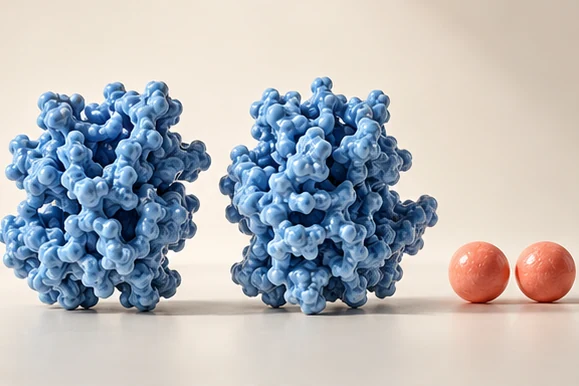
- A biosimilar must be highly similar to its reference biologic with no clinically meaningful differences in safety and effectiveness.
- Comparative structural and functional studies form the foundation of the biosimilar evidence package.
- Interchangeability concerns substitution rules, not a higher tier of clinical quality.
The difference begins with what is being made
Many familiar medicines have relatively small active molecules that can be characterized and reproduced through chemical manufacturing. Biological medicines are often larger, more complex products made using living systems. Producing, purifying, and maintaining them can be more complicated. FDA explains that minor variation is normal even between batches of an original biologic, not only between an original and a proposed biosimilar. [1]
This does not mean biological manufacturing is uncontrolled. It means the meaningful question is which properties must remain consistent and whether observed variation affects treatment. The word similar should not be read as approximately effective. It describes a regulatory and scientific comparison appropriate to complex biological products, rather than a weaker ambition for the patient's outcome.
The reference product anchors the argument
A biosimilar is compared with an already approved biological medicine called its reference product. Under the FDA framework, it must be highly similar and have no clinically meaningful differences in safety, purity, and potency, which the agency explains in terms of safety and effectiveness. The existing evidence for the reference product is part of the logic of the abbreviated development pathway. [2]
The goal is therefore different from developing an entirely new medicine. A new product program must establish its own treatment proposition. A biosimilar program asks whether the proposed product can rely on the reference product's established findings because biosimilarity has been demonstrated. FDA explains that both generics and biosimilars have abbreviated pathways that avoid unnecessary duplication, while requiring different evidence appropriate to the products involved. [1] [2]
The laboratory comparison is foundational
FDA describes comparative analytical studies as the foundation of biosimilar development. These studies examine structural and functional similarity and assess the impact of differences. This is not merely a visual comparison of two molecular diagrams. The evidence needs to address properties relevant to the medicine's biological activity, alongside other quality considerations. A detectable difference is a question to investigate, not automatic proof of a clinical problem. [2]
Imagine, hypothetically, two versions of a therapeutic protein that show a small analytical difference. The appropriate response is to ask whether the difference alters a relevant function or creates uncertainty about safety and effectiveness. Neither ignoring every difference nor rejecting every difference would make scientific sense. The comparison must connect measurements to the biological behavior that matters for the particular product.
Clinical evidence addresses what remains uncertain
The FDA review page describes pharmacology studies that can compare how products move through the body and their effects, as well as assessments of immune responses to the products. Other comparative clinical studies may be used to address remaining uncertainty. The agency evaluates proposed biosimilars individually and can determine that a particular evidence component is unnecessary. A fixed count of trials is not the definition of a rigorous application. [2]
This helps explain why repeating every original efficacy trial is not always the best use of evidence. If a sensitive structural and functional comparison has resolved an important question, a large clinical study may not add the same kind of information. Conversely, unresolved differences cannot be made irrelevant by calling the pathway abbreviated. The strength of the argument lies in how the evidence fits together, not in how closely it reproduces the reference product's development history.
Extrapolation is a scientific bridge
FDA can approve a biosimilar for a reference-product indication or population without a separate direct clinical study in every such setting, provided there is adequate scientific justification. This is called extrapolation. The review considers the application as a whole, the reference product's established findings, and scientific factors relevant to the indications. Extrapolation is not permission to assume that any similar-looking biologic treats any related disease. [2]
The distinction matters when interpreting an approval summary. A reader may reasonably ask whether a particular indication was directly studied, but the answer alone does not determine whether the approval was justified. The next question is what evidence supports applying the biosimilarity conclusion to that indication. This is a structured reliance on existing knowledge, not an assertion that all diseases or mechanisms are interchangeable.
Interchangeability and cost are separate questions
In the United States, an interchangeable biosimilar may be substituted for its reference product without consulting the prescriber, subject to state pharmacy law. FDA explicitly states that this designation does not mean it is safer or more effective than another approved biosimilar. It concerns requirements associated with substitution. A biosimilar without that designation should not be described as an inferior treatment merely because automatic substitution is handled differently. [1] [2]
Biosimilars may also create more affordable options, but an individual patient's cost depends on insurance, coverage, and other practical arrangements. FDA does not control those prices or guarantee savings. The useful conclusion is specific: approved biosimilars meet a rigorous similarity standard, while substitution and affordability have additional rules and circumstances. Conflating those three questions makes both scientific and financial headlines less informative. [1]
What this does not establish
This article explains the U.S. FDA framework, not the rules in every jurisdiction. Biosimilar status does not imply that a product is a cell therapy or gene therapy; the assigned category groups related biological-medicine coverage. Specific labeling, interchangeability designations, state substitution rules, and coverage should be checked for the product concerned. No universal switching-study requirement or guaranteed patient savings is asserted.
Sources & further reading
Source records for this public draft are listed below with their historical access dates. Source checking is not medical validation or completed human editorial review.
- Biosimilars Basics for Patients ↗
U.S. Food and Drug Administration · Accessed 2026-09-11
Biologic complexity and batch variation, differences from generics, no clinically meaningful differences, interchangeability, and uncertain individual cost savings.
- Review and Approval ↗
U.S. Food and Drug Administration · Accessed 2026-09-11
Reference-product reliance, analytical foundation, individualized evidence requirements, pharmacology and immunogenicity assessment, extrapolation, and substitution-related designation.
Educational information only. Not medical or financial advice. Do not change treatment or investment decisions based on this draft.