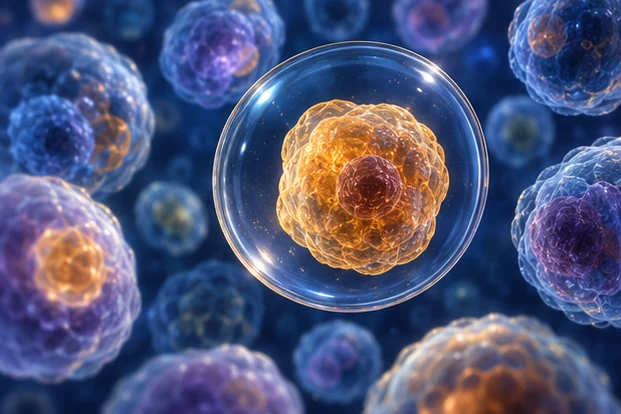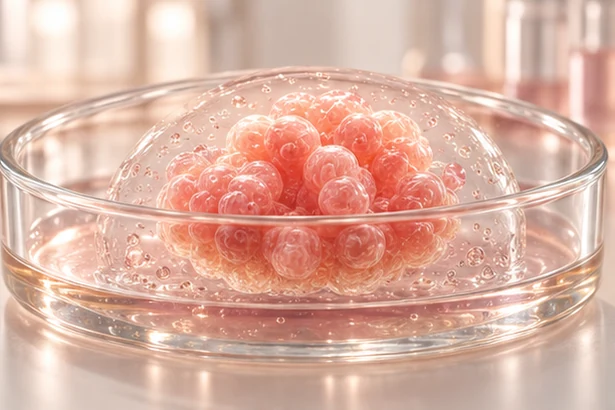
- An organoid models selected tissue properties rather than an entire functioning organ or person.
- Cell source, culture conditions, and missing vascular or immune components shape what experiments can reveal.
- A response in a patient-derived organoid needs validation before it can guide a clinical decision.
Self-organization is not complete reproduction
An intestinal organoid can reproduce useful epithelial behavior without reproducing digestion, circulation, nervous control and immunity together. That selective resemblance makes it a model, not a miniature patient. An organoid is a three-dimensional tissue model in which cells organize into structures resembling selected aspects of an organ. Neighboring cells exchange signals, arrange into distinct regions and interact with surrounding material. The practical question is which of those behaviors the experiment needs. [1]
The phrase miniature organ can therefore help introduce the concept while misleading about its completeness. The important question is not how convincingly a model resembles an organ in a photograph. It is whether the model reproduces the biological process being investigated. A simplified model can be excellent for one question and unsuitable for another, even when both questions concern the same disease.
The starting cells constrain the experiment
Organoids can begin with adult tissue stem cells, pluripotent stem cells, or patient tumor material. Induced pluripotent stem cells are cells reprogrammed into a state from which multiple specialized cell types can be generated. Researchers then provide culture conditions and developmental signals that favor the tissue of interest. Adult tissue-derived cultures follow a different starting route and often preserve useful properties of their source tissue. These are related approaches, not identical products. [1]
The cell source influences which populations can emerge, which genetic features are retained, and what comparison is possible. A patient-derived tumor organoid may preserve features worth testing without preserving every population in the original tumor. An organoid made from pluripotent cells may be especially useful for developmental questions, while still requiring evidence that its state matches the disease stage under study. Being human-derived does not automatically make a culture an adult human organ.
The missing plumbing changes the biology
Cells need oxygen and nutrients and must remove waste. In a small culture, molecules can diffuse through the surrounding medium. As tissue grows, diffusion alone can become inadequate, especially toward its center. Reviews of organoid engineering describe growth limits and cell death in internal regions when vascular supply is missing. A necrotic center is not merely an unattractive technical flaw; it can change the signals and stress responses being measured. [1] [2]
Blood vessels also do more than transport supplies. Vascular cells exchange signals with surrounding tissue and help organize development. Researchers investigate endothelial-cell coculture, microfluidic systems, engineered channels, and transplantation into animals to address these gaps. A vessel-like structure is not necessarily a functional, perfused vascular network. Likewise, an organoid supported by a mouse's circulation has become a mixed experimental system, not an isolated demonstration of human physiology. [2]
Context can reverse an interpretation
Many organoids omit immune cells or include only selected immune populations. That matters when the question concerns inflammation, infection, or a therapy that depends on immune killing. Adding immune cells can make the model more relevant, but introduces further choices about cell origin, compatibility, and culture conditions. More complexity is useful only when it improves the model's ability to answer the intended question. [1]
Consider a hypothetical cancer drug that kills tumor organoids grown alone but produces little effect when immune and supporting cells are added. The difference could reveal protection supplied by neighboring cells, altered drug access, or changed growth conditions. It would not justify declaring the simpler experiment fraudulent or the more complex experiment automatically correct. It would identify a contextual variable that needs controlled investigation.
Read the swelling assay, then test its reach
For an intestinal model, swelling can be a more informative result than an organ-like photograph. The vascularization review describes intestinal organoid swelling as a readout of cystic fibrosis transmembrane conductance regulator, or CFTR, function. Fluid movement can make the structure expand, connecting a visible change to a biological process. That is a more precise claim than saying an organoid looks healthier after treatment. The assay's interpretation still depends on appropriate controls and validation. [2]
For disease modeling, useful comparisons might include multiple donors, independent cultures, and a genetic change tested against an otherwise closely matched background. Researchers should ask whether effects repeat across preparations and whether the same readout relates to disease in patients. A visually impressive single organoid is an observation, not a population estimate. Variation between cultures may be informative biology, technical variation, or both.
Testing a patient's cells can generate hypotheses about treatment sensitivity, but the patient also has drug metabolism, immune responses, other organs, and a treatment history that a dish cannot fully reproduce. A clinical test needs evidence linking its result to outcomes and showing that using it improves decisions. Organoids can narrow uncertainty and expose mechanisms without eliminating the need for clinical studies. Their strength is controlled access to otherwise inaccessible human biology, not the replacement of an entire person with a small culture.
What this does not establish
Organoid is a broad label covering substantially different tissues and protocols. The cited reviews describe capabilities and engineering gaps, not universal performance standards or a clinical endorsement of every organoid assay. Examples involving transplantation are animal research. Neither three-dimensional organization nor neural activity alone establishes whole-organ function, personhood, or the clinical usefulness of a model. Specific applications require their own validation and ethical review.
Sources & further reading
Source records for this public draft are listed below with their historical access dates. Source checking is not medical validation or completed human editorial review.
- Give Them Vasculature and Immune Cells: How to Fill the Gap of Organoids ↗
PubMed Central (peer-reviewed review repository) · Accessed 2026-09-11
Organoid cell sources, three-dimensional self-organization, missing vascular and immune components, and coculture or transplantation strategies.
- Engineering Organoid Vascularization ↗
Frontiers in Bioengineering and Biotechnology / PubMed Central · Accessed 2026-09-11
Diffusion and necrotic-core limitations, vascular engineering, animal engraftment, and CFTR-dependent intestinal organoid swelling as a functional readout.
Educational information only. Not medical or financial advice. Do not change treatment or investment decisions based on this draft.