- Target binding, biological activity, and clinical benefit are separate requirements.
- Antibody engineering balances recognition, immune activity, exposure, and manufacturability.
- Targeted medicines can still harm healthy tissue and provoke immune reactions.
Start with a biological reason to bind
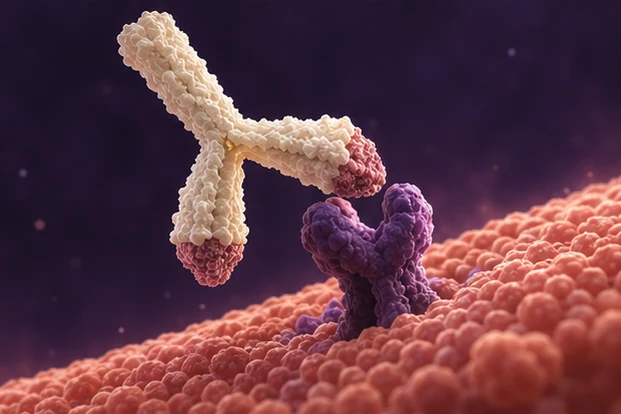
Antibodies are proteins that recognize particular molecular features. Therapeutic antibodies borrow this recognition capability, but a useful binder is not automatically a useful medicine. Development begins with a biological hypothesis: blocking this signal, removing this cell population, or recruiting this immune response should improve a disease. If that hypothesis is wrong, even an exceptionally selective antibody can fail to help patients. [1]
NCI describes several ways antibodies act against cancer. Some mark cells for immune destruction, some bring immune cells close to cancer cells, and others interfere with growth signals or deliver cell-killing substances. These mechanisms require different properties. An antibody designed to neutralize a circulating signal does not face exactly the same engineering problem as one meant to recruit a T cell beside a tumor. [2] [3]
Recognition must become a functional effect
Discovery methods generate candidate antibodies and screen their binding. Researchers then ask what that binding actually does in a relevant assay. Does the antibody prevent a receptor from receiving a signal? Does it leave signaling unchanged? Could it instead activate the receptor? The review of antibody optimization distinguishes discovery based on antigen binding from lead selection based on biological function. That distinction is central to avoiding an attractive but unproductive candidate. [1]
Affinity describes how strongly an antibody binds its target under specified conditions. Specificity concerns what it recognizes relative to other possible targets. Neither is a complete measure of therapeutic quality. In a hypothetical screen, two antibodies might bind the same protein strongly, yet only one block the particular interaction driving disease. Improving the other antibody's affinity would not necessarily fix the mismatch between its binding location and the desired mechanism.
An antibody has more than a targeting end
For many conventional therapeutic IgG antibodies, variable regions provide target recognition while the Fc region can interact with immune machinery. Fc interactions can recruit immune cells or complement, a system of proteins involved in immune defense. Engineers can alter these interactions to change what follows binding. More immune recruitment may be useful for removing unwanted cells, but inappropriate when the goal is simply to block a signal without killing the cell that carries it. [1]
There are also formats that depart from a conventional antibody. NCI describes blinatumomab as binding CD19 on certain target cells and CD3 on T cells, bringing the two cell types together. Antibody-linked payload approaches add another layer: the targeting component, connection to the payload, and payload activity all contribute to performance. Success of one format is not evidence that all molecules sharing a target will behave the same way. [2] [3]
A candidate must survive practical reality
An antibody can perform well in a binding assay and still be difficult to develop. The optimization review treats manufacturability and other physicochemical properties as part of candidate selection, not as cleanup after discovery. Developers must produce material consistently, preserve useful properties, and avoid unwanted behavior such as aggregation. A change that improves one attribute can worsen another, making optimization a balancing exercise rather than a race toward a single maximum. [1]
The body introduces further constraints. Exposure must be sufficient at the relevant site, and the immune system may recognize the medicine itself. Humanization can reduce the foreign character of antibodies originating from nonhuman sources, but it does not guarantee the absence of anti-drug immune responses. The review identifies multiple influences on immunogenicity, including sequence, aggregation, dose, and administration route. A label such as humanized is a design description, not a promise of zero immune risk. [1]
Targeted does not mean harmless
A target can be important in disease and still perform necessary work in healthy tissue. Rituximab, for example, recognizes CD20 on B cells, including normal B cells as well as relevant cancer cells. The mechanism is specific at the molecular level without being restricted to malignant cells. This is one reason specificity and safety should not be treated as interchangeable words. [2]
NCI also describes infusion-related allergic reactions and other potentially serious effects of therapeutic antibodies. The relevant risks vary by medicine, dose, patient, and mechanism; a list of possible class effects is not the probability that a particular patient will experience each one. Similarly, shrinking a tumor or changing a blood marker is not automatically evidence of longer survival, improved symptoms, or a favorable overall balance of benefit and harm. [2] [3]
The final test is an evidence chain
A convincing development story connects target biology, binding, functional assays, exposure, tolerability, and clinical outcomes. Each connection can fail independently. A cancer may lose dependence on the targeted pathway or change the target, creating resistance even when the antibody retains its original properties. NCI describes both target changes and alternative growth routes as problems for targeted therapy. A medicine is therefore not simply an engineered protein that binds well; it is a product whose intended use has survived a sequence of biological and clinical tests. [3]
What this does not establish
Cancer examples illustrate mechanisms but do not summarize all antibody uses. Different targets and formats have different tissue access, immune effects, and dosing requirements. The sources include an engineering review and patient-facing NCI summaries rather than a systematic comparison of individual drugs. No numerical efficacy ranking, individual treatment recommendation, or current product-label inventory is inferred from them.
Sources & further reading
Source records for this public draft are listed below with their historical access dates. Source checking is not medical validation or completed human editorial review.
- Optimization of therapeutic antibodies ↗
Antibody Therapeutics / PubMed Central · Accessed 2026-09-11
Discovery-to-development workflow, functional lead selection, affinity and specificity, Fc engineering, humanization, immunogenicity, and developability tradeoffs.
- Monoclonal Antibodies ↗
National Cancer Institute · Accessed 2026-09-11
Antibody recognition, rituximab and blinatumomab mechanisms, normal-cell targets, and variable adverse effects.
- Targeted Therapy for Cancer ↗
National Cancer Institute · Accessed 2026-09-11
Signal blocking, payload-bearing antibodies, biomarker selection, serious toxicity, and resistance through target changes or alternate growth pathways.
Educational information only. Not medical or financial advice. Do not change treatment or investment decisions based on this draft.