Vir Biotechnology and Gilead signed a collaboration on October 9 and announced it October 14 to discover and engineer three PRO-XTEN dual-masked T-cell engager development candidates for selected solid-tumor antigens. Vir will discover, design and optimize them; Gilead has an exclusive license to nominate and advance candidates and will handle subsequent development, manufacturing and commercialization. The word candidate matters: the agreement is not a report of human efficacy for these three programs. [1][2]
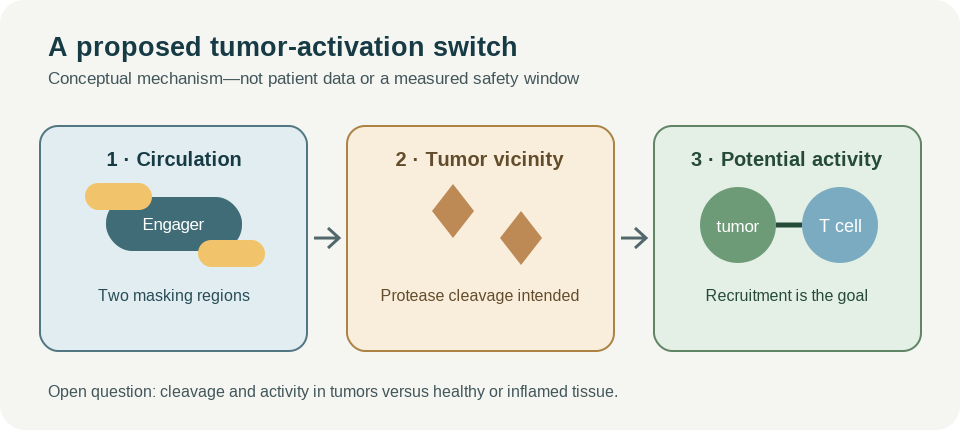
What the two masks are supposed to accomplish
A T-cell engager brings a tumor-antigen-binding region and a T-cell-binding region (commonly CD3) into functional proximity. If an antigen also appears on healthy cells, an always-active engager can recruit immune attack where it is unwelcome. Vir says PRO-XTEN is designed to keep the molecule masked in circulation and to extend its half-life. Tumor-associated proteases are intended to cut away the masking components in the tumor microenvironment, exposing activity there. The company proposes that this could widen the therapeutic index and permit less frequent dosing. Those are design goals, not measured outcomes of this collaboration. [2]
The make-or-break comparison is cleavage in tumor tissue versus relevant normal and inflamed tissue. A mask that comes off in both places could preserve the original toxicity problem; one that stays on in the tumor could sacrifice activity. The announcement supplies neither comparison for these three candidates. Tumors vary in protease activity, blood supply, antigen abundance and access by T cells. Normal or inflamed tissues may also contain relevant protease activity or the target antigen. A molecule that escapes its mask too soon might cause off-tumor toxicity; one that stays masked in a tumor might lack efficacy. How much cleavage occurs in each compartment, how long the active form persists, and how much normal-tissue exposure remains are empirical questions. The announcement does not identify the three selected antigens or provide measurements answering them. [1][2]
A peer-reviewed 2020 preclinical study of a different protease-activated T-cell engager architecture, COBRA, demonstrated MMP9-dependent activation and regression of xenograft tumors in mice. It supports the feasibility of conditional activation as a general strategy, not the safety or efficacy of Vir’s PRO-XTEN constructs. The COBRA mouse experiments cannot establish a human tumor-versus-normal-tissue safety window. It would be incorrect to transfer those mouse results or potency measurements to Gilead’s undisclosed candidates. [3]
Deal arithmetic without the headline trap
| Component | What the October 14 company release says | What is established now |
|---|---|---|
| Upfront consideration | $90 million: $65 million cash and a $25 million equity investment at a 30% premium | The equity leg is a proposed share purchase, not another $25 million cash license payment. The 8-K says 1,765,486 shares at $14.16 each, approximately $25 million, subject to customary closing conditions. [1][2] |
| Near-term preclinical milestones | Up to $45 million | Conditional on specified progress; not already earned. [2] |
| Further development, regulatory and commercial milestones | Up to $1.74 billion | A maximum contingent amount across stages, not a guaranteed payment or present valuation. [2] |
| Royalties | Tiered high-single-digit to low-double-digit percentages of net sales | Depend on future marketed products and sales, neither established here. [2] |
The release aggregates upfront consideration and near-term preclinical milestones as up to $135 million ($90 million + $45 million). Adding $1.74 billion produces an approximately $1.875 billion ceiling before royalties, but only by combining an upfront package, conditional preclinical events and much later hypothetical milestones. That arithmetic is not cash on hand, realized revenue, program valuation or a probability-weighted forecast. The SEC filing verifies the separate stock-purchase terms and its closing condition; the SEC-filed Exhibit 99.1 supplies the wider economics. [1][2]
The evidence ladder to watch
First, discovery work must produce actual candidates with specified antigens and reproducible properties. A useful preclinical comparison would quantify activity before and after cleavage, protease selectivity, cleavage in tumor versus relevant normal and inflamed tissues, antigen distribution, pharmacokinetics and active-molecule exposure. Controls should include an unmasked engager and a noncleavable masked version so that weaker systemic activity is not mistaken for better tumor selectivity. Tumor killing and cytokine signals are both relevant. Even a favorable animal therapeutic index cannot substitute for human safety and activity data.
Next would come manufacturing, regulatory submissions and clinical trials that examine dose, cytokine-release and other toxicities, off-tumor effects, and tumor response with appropriate follow-up. Nothing in the October announcement establishes that these three candidates have entered trials. Vir describes other clinical-stage oncology programs in its portfolio, but those must not be confused with candidates proposed under this new agreement. [2]
The collaboration is a clear commercial commitment to test a plausible way around a real solid-tumor challenge. Its strongest current evidence is the signed agreement and articulated design. Whether dual masking actually buys a wider human safety window—and whether any nominated candidate controls cancer—remains open.
Limitations: Company statements and an SEC filing establish the agreement and terms, not experimental validation of these three candidates. The independent paper studies a different platform in preclinical models. No selected antigen, candidate-level dataset, human safety or efficacy estimate is supplied. Not medical or investment advice.
Sources
- [1] Vir Biotechnology, Form 8-K, filed October 14, 2026
October 9 agreement and proposed equity purchase, subject to closing. Checked October 16, 2026.
- [2] Vir Biotechnology, SEC-filed Exhibit 99.1, October 14, 2026
Company-announced collaboration scope, proposed mechanism and contingent financial terms. Checked October 16, 2026.
- [3] COBRA preclinical study, mAbs (2020)
Independent context on a different conditional engager platform in preclinical models, not evidence for Vir’s candidates. Checked October 16, 2026.
Not independently medically reviewed. Not medical or investment advice.