
- A surrogate substitutes for a direct measure of feeling, functioning, or survival.
- Association with prognosis does not by itself validate a marker as a substitute for treatment benefit.
- Validation is context-specific, and harms or confirmatory outcomes can change the interpretation.
The shortcut solves a real research problem
Some outcomes take years to observe. If researchers had to wait for every stroke, fracture, or death before learning whether a treatment showed promise, studies could become slow and difficult to conduct. A surrogate endpoint offers a potential shortcut: measure something earlier that can stand in for the clinical outcome of interest. FDA distinguishes these substitutes from direct measures of how people feel, function, or survive. [1]
The appeal is practical, not inherently deceptive. A well-supported surrogate can allow informative studies with shorter follow-up or fewer participants. The problem begins when a convenient measurement is treated as though its clinical meaning were self-evident. A precise laboratory result can still be an uncertain guide to whether a treatment improves someone’s life.
A biomarker has a job, not a universal meaning
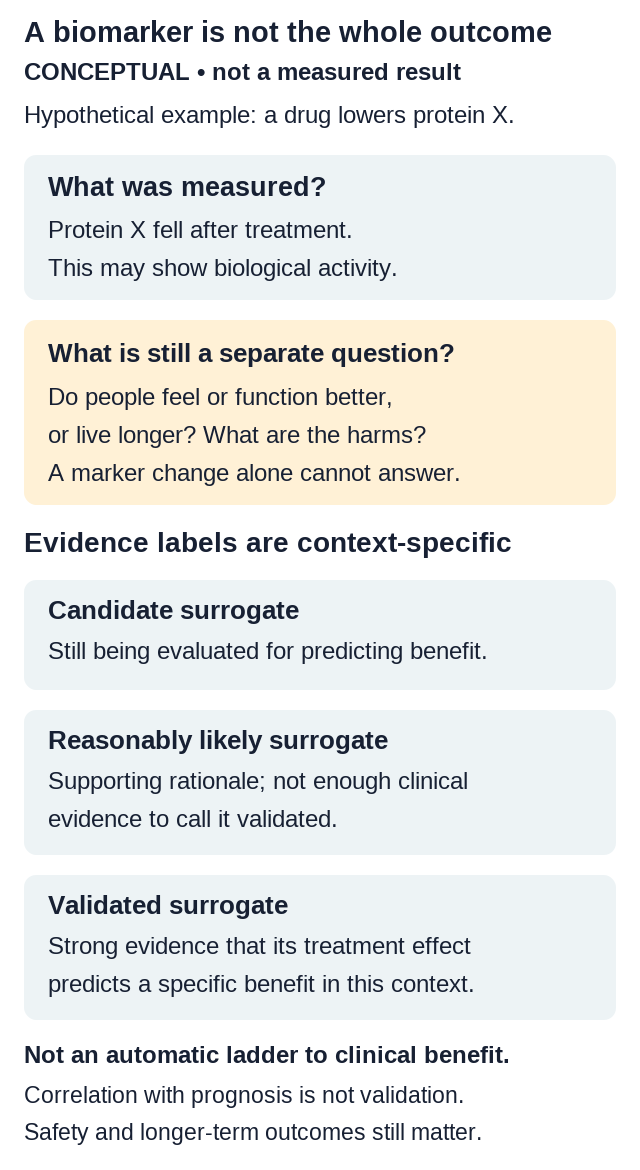
Biomarkers are measurable characteristics that can indicate biological processes or responses to an intervention. Their jobs differ. One may help diagnose disease, another identify patients for a trial, and another show that a drug reached its intended target. Only some biomarkers function as surrogate endpoints. Evidence that a molecule changed after treatment may demonstrate biological activity without demonstrating clinical benefit. [1]
Consider a hypothetical inflammatory disease. People with higher protein X have worse symptoms, and a new drug lowers protein X. It is tempting to conclude that the drug must relieve the disease. But the protein could be a consequence of tissue damage rather than a cause, or the drug could lower the laboratory signal without stopping the damaging process. The association generates a hypothesis; it does not complete the argument.
Predicting prognosis is different from predicting treatment effects
A prognostic marker separates people with different expected outcomes. A useful surrogate must do something more demanding: support an inference that an intervention’s effect on the marker predicts its effect on a clinical outcome in the relevant setting. A marker can correlate strongly with disease severity yet fail this test when a treatment changes the marker by an unexpected route.
Imagine two hypothetical drugs that lower protein X equally. One also repairs tissue; the other has an unrelated toxicity that worsens health. Identical marker changes would not imply identical patient outcomes. The lesson is not that biomarkers are useless, but that the whole biological pathway and the treatment’s other effects matter. FDA describes the need for mechanistic reasoning together with clinical and other scientific evidence. [1]
Read the validation label carefully
FDA describes candidate, reasonably likely, and validated surrogate endpoints. A candidate is still being evaluated. A reasonably likely surrogate has supporting rationale but insufficient clinical evidence to be considered validated. A validated surrogate has stronger evidence that an effect on it predicts a particular clinical benefit in a particular context. These categories reflect different levels of confidence, not three stylistic ways to describe the same measurement. [1]
Context is essential. Evidence for a marker in one disease or treatment class may not establish its value in another. FDA uses blood-pressure reduction as an example supported by multiple trials linking treatment-related reductions with reduced stroke risk. That does not mean any intervention that changes any cardiovascular marker automatically earns the same evidentiary trust. The supporting chain must fit the intended use.
Ask what the endpoint leaves out
A tumor response, a laboratory concentration, and a patient’s ability to work or walk answer different questions. Even a genuine effect on disease biology can coexist with side effects, inconvenience, or limited durability. Trials therefore continue collecting safety information as development advances. A benefit-risk judgment cannot be read from a single favorable biomarker graph. [2]
The timing also matters. A short-lived marker response may not predict sustained benefit. A composite endpoint can blur the distinction by combining a clinical event with a laboratory change; readers should inspect the components and which one drove the result. Similarly, earlier detection of disease can increase measured survival after diagnosis without extending life, illustrating how a plausible intermediate measurement can mislead about the ultimate outcome. [3]
Regulatory usefulness is not an evidence-free pass
Surrogate endpoints can support traditional approval when adequately validated. FDA also describes accelerated approval based on endpoints reasonably likely to predict benefit in appropriate serious-disease settings, with further evidence needed to evaluate the expected clinical benefit. That pathway makes the remaining uncertainty part of the story, rather than turning a surrogate result into proof that the final outcome has already improved. [1]
For a new announcement, ask which endpoint changed, whether it was prespecified, what evidence supports it as a surrogate here, and what patient-centered outcomes have actually been measured. Then ask what follow-up or confirmatory evidence would change the conclusion. The most accurate summary might be that a treatment improved a promising intermediate measure while its effects on longer-term health remain under study.
A surrogate is best understood as a bridge between an observation and a claim. Sometimes the bridge has been tested repeatedly and carries substantial weight. Sometimes it is still under construction. Good communication identifies which situation applies instead of pretending the river is not there.
What this does not establish
Surrogate validity differs by disease, intervention, population, and intended clinical benefit. This explainer does not rate any specific product or assert that all uses of a named biomarker are validated. Regulatory decisions require indication-specific evidence, and an educational example cannot resolve that evidence assessment.
Sources & further reading
Source records for this public draft are listed below with their historical access dates. Source checking is not medical validation or completed human editorial review.
- Surrogate Endpoint Resources for Drug and Biologic Development ↗
U.S. Food and Drug Administration · Accessed 2026-09-11
Clinical versus surrogate endpoints; candidate, reasonably likely, and validated surrogates; context-specific validation.
- How Do Clinical Trials Work? ↗
National Cancer Institute · Accessed 2026-09-11
Eligibility, trial phases, randomized allocation, comparators, and continuing safety assessment.
- What Cancer Screening Statistics Really Tell Us ↗
National Cancer Institute · Accessed 2026-09-11
Absolute versus relative mortality reduction, lead-time bias, length bias, and why diagnosis-based survival can mislead.
Educational information only. Not medical or financial advice. Do not change treatment or investment decisions based on this draft.