Entrada’s first ENTR-601-45 cohort supplies an early molecular signal and a small safety dataset—not evidence that the investigational medicine improves walking or changes Duchenne muscular dystrophy’s course. The company’s October 14 announcement supplies an unusually explicit limit: no observable functional benefit was expected or observed after three doses. [1]
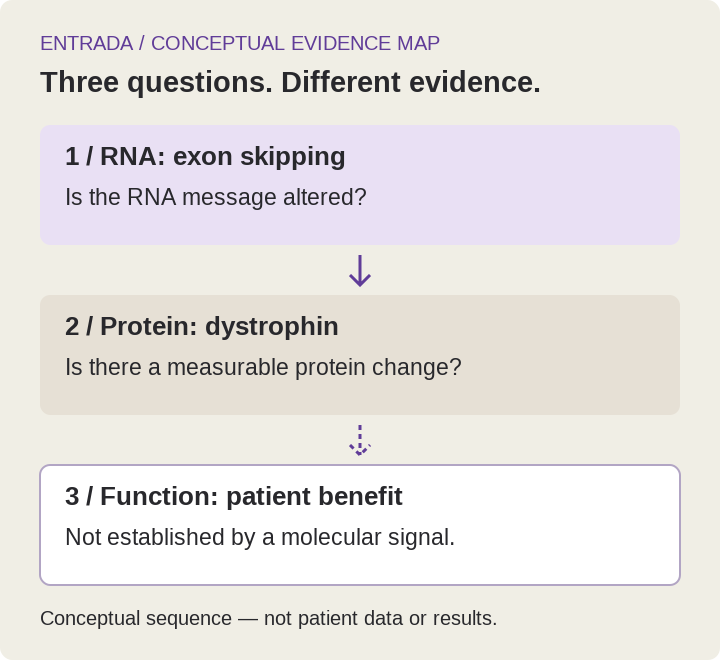
Three questions, three different kinds of evidence
ENTR-601-45 is designed to promote exon 45 skipping in a genetically defined subset of people with Duchenne. The intended sequence is an altered RNA message, production of shortened dystrophin, and ultimately a useful clinical effect. Those steps are related, but evidence for one does not establish the next. [1]
- Can this dose be administered with acceptable short-term tolerability?: Company-described favorable tolerability; no discontinuations. Limitation: Rare harms, longer exposure and higher-dose safety
- Is there a molecular change?: Reported increases in dystrophin and exon skipping. Limitation: Precision, reproducibility, dose response and relationship to clinical benefit
- Do patients function better?: No observable benefit reported after three doses. Limitation: Longer-term controlled functional outcomes
The denominator is part of the result
ELEVATE-45-201 Cohort 1 enrolled eight participants, randomized 3:1 to ENTR-601-45 or placebo. Treatment was 5 mg/kg intravenously on days 1, 43 and 85; biopsies were taken at screening and six weeks after the last dose. The trial’s eligible Part A population is ambulatory participants aged 4–20 with mutations amenable to exon 45 skipping; that eligibility range is not a description of the eight participants’ actual ages. [1][2]
- Dystrophin change from baseline: Mean increase “0.10%,” n=6, nominal p=0.03; placebo mean decrease “0.02%”. Limitation: These are the release’s quoted units, not a claim of a 10% improvement or a clinical effect. The nominal p-value is reported alongside the treated-group change; the release does not identify its statistical test or multiplicity adjustment, so it should not be presented as a verified between-arm comparison.
- Exon-skipping change from baseline: Mean increase “0.15%,” n=5, no p-value calculated; placebo mean decrease “0.04%”. Limitation: The treated analysis denominator differs from the dystrophin denominator. The release text does not explain that difference.
- Serious treatment-emergent events: One participant experienced vomiting and pyrexia, both resolved. Limitation: Two events in one participant are not two affected participants; treatment-emergent does not by itself establish causation.
- Other safety observations: Headache: five events in two participants; no hypomagnesemia or renal safety concerns reported. Limitation: A small initial cohort cannot establish the absence of uncommon or cumulative harms.
The release says dystrophin was measured by Western blot and normalized to myosin heavy chain. Its assay note gives a lower limit of quantification of 0.25% and a detection limit of 0.1%, and says actual observed values below the quantification limit were included. Two treated participants had baseline values below the quantification limit but above the detection limit. [1]
This is a reason to examine the underlying assay data and uncertainty, not to declare the entire signal invalid. A lower limit of quantification applies to measured concentrations or levels; it should not be mechanically treated as a threshold that every change score must exceed. Equally, a nominal p-value does not resolve measurement uncertainty or prove a clinically meaningful effect. Full participant-level values, assay validation, confidence intervals and the statistical analysis plan would make the topline result more interpretable.
A useful comparison that is not an efficacy claim
The study’s every-six-week schedule offers a practical hypothesis: 52 weeks divided by six is approximately 8.7 dosing intervals per year, versus approximately 52 for weekly treatment. That is the arithmetic behind Entrada’s “approximately nine” versus “more than fifty” administrations framing—not a demonstrated reduction in total care burden. Infusion duration, monitoring, adverse events and durability still matter. Nor does the arithmetic show that this investigational regimen can replace an approved treatment. [1]
What the registry adds—and does not add
ClinicalTrials.gov identifies the protocol as ENTR-601-45-201, NCT07038824. Its record lists treatment-emergent adverse events as the primary outcome and dystrophin, exon skipping and functional measures among secondary outcomes. The retrieved record estimates 24 participants across the registered study, not 24 in this eight-person cohort. It lists masking of participants, care providers, investigators and outcome assessors, consistent with a blinded comparison rather than an uncontrolled first-cohort study. [2]
The registry’s last posted update was August 13, 2026, before the announcement. It corroborates design and planned endpoints; it is not independent verification of the October results. Its longer outcome windows must not be confused with the first cohort’s six-week post-final-dose biopsy timing. The company says all eight participants continued into an open-label period; loss of blinding there also changes how later functional observations should be interpreted. [1][2]
What would strengthen the next update?
A persuasive next readout would connect four things: higher exposure, a reproducible molecular response, tolerability at that exposure, and functional outcomes over an appropriate interval. It should show individual trajectories and uncertainty, explain missing assays, and distinguish controlled comparisons from open-label follow-up.
Entrada says the 10 mg/kg second cohort is fully enrolled and expects results in the first half of 2027. That is a company forecast, not a completed result. Its expectation of higher dystrophin production and functional benefit in future cohorts remains a hypothesis. [1]
The first cohort therefore earns a narrower conclusion: the program has reported an initial biomarker change and short-term safety observations worth following. The next cohort needs to show whether a larger, reproducible dystrophin response is accompanied by better function—not merely another positive headline. That is a question for further evidence, not a claim that this cohort rules out future benefit.
Primary sources
- [1] Entrada Therapeutics, SEC Exhibit 99.1, October 14, 2026
Announcement and baseline-characteristics graphic checked October 15, 2026. Company-reported topline results, not independent replication.
- [2] ClinicalTrials.gov: NCT07038824
Registry API checked October 15, 2026; last update posted August 13, 2026. Trial design and planned endpoints, not a results verification.
Not independently medically reviewed. Not medical or investment advice.