October 30, 2026 update: final prospectus terms
Aspen’s final prospectus, dated October 29 and filed October 30, specifies 9,375,000 shares at $15 each: $140,625,000 gross, before underwriting discounts and expenses. It states that Nasdaq listing under ASPE has been approved and that underwriters expect delivery November 2, 2026. Expected delivery is not completed settlement; this document alone does not establish that trading has begun. The original analysis below describes the October 9 S-1 as checked October 14; its clinical and financial cutoffs remain historical. [4]
- Aspen is developing a patient-specific cell-replacement approach to a major unmet need in Parkinson’s disease.
- A hypothetical $500 billion one-time arithmetic ceiling—not a verified sales market—assumes an unverified price and near-universal uptake.
- Its filing describes encouraging observations in an early 15-person study, but without a control group those observations cannot establish efficacy.
- The final prospectus sets 9,375,000 shares at $15; delivery is expected November 2, 2026. Clinical outcome and investment return remain unknown.
Why the approach is drawing attention
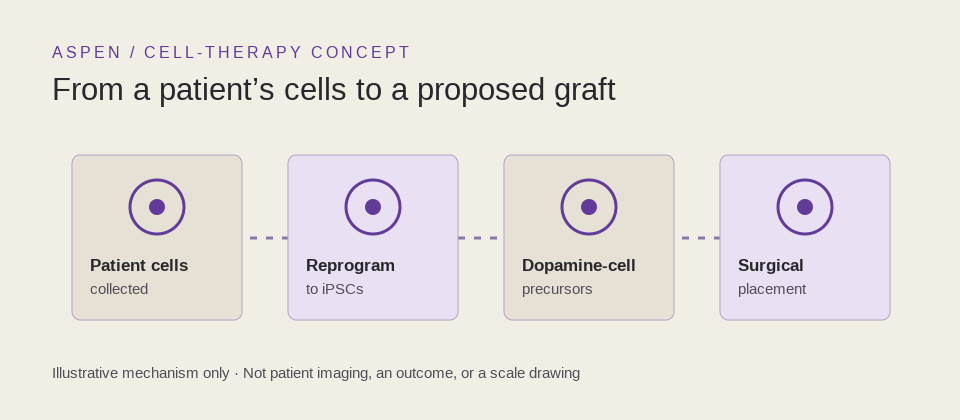
Aspen’s lead candidate, sasineprocel, is an investigational autologous induced-pluripotent-stem-cell-derived therapy for Parkinson’s disease. In broad terms, a patient’s own cells are reprogrammed, directed toward dopamine-neuron precursor cells and implanted through a neurosurgical procedure. The ambition is compelling: replace lost dopaminergic function with cells derived from the same patient, potentially avoiding the immunosuppression often associated with donor-derived approaches. Aspen reports no post-administration immunosuppression requirement in ASPIRO. This is a biological rationale and a therapeutic hypothesis—not proof that the treatment restores function or slows disease progression in patients. [1]
The filing describes the Phase 1/2a ASPIRO trial as open-label. As of its August 18, 2026 data cutoff, 15 people had received a dose: seven in a low-dose group and eight in a high-dose group. Aspen reports observations across motor, daily-living and quality-of-life measures and describes the treatment as generally well tolerated so far. Its account also reports 72 treatment-emergent adverse events and two serious events related to surgery in one participant. Those observations justify careful follow-up, not dismissal. They remain company-reported interim data rather than independently replicated efficacy findings. [1]
For background on the method, see our explainers on stem cells and organoids and how to read a clinical trial; those general concepts do not establish that this candidate works.
What a hypothetical $500 billion ceiling would require
The potential need is substantial. The Parkinson’s Foundation estimates that about 1.1 million people in the United States and more than 10 million worldwide live with Parkinson’s disease; nearly 90,000 Americans are newly diagnosed each year. If a one-time cell therapy eventually proves durable benefit, those figures illustrate why a successful approach could matter to many patients. They are population and incidence estimates, not the number of patients eligible for sasineprocel or a dollar-valued total addressable market. [3]
For an intentionally aggressive back-of-the-envelope ceiling, multiply approximately 1.1 million U.S. patients by a hypothetical $500,000 one-time treatment price: about $550 billion, or roughly $500 billion when rounded. The $500,000 figure is an illustrative assumption, not Aspen’s announced price or a verified reimbursement rate. This assumes nearly everyone with Parkinson’s could and would receive this investigational neurosurgical treatment at that price—conditions that are not established. It is a gross one-time arithmetic exercise, not an annual market, a realistic eligible-patient estimate, a revenue forecast or a company valuation. [1,3]
Aspen is initially studying mid-stage to moderately advanced Parkinson’s, not every person counted in prevalence statistics. Trial results, the eventual approved label, surgical suitability, patient preference, manufacturing capacity, reimbursement and access would determine the reachable population and potential revenue. The filing does not establish a reliable sales TAM, and none of these population counts predicts investment returns. [1,3]
What the filing says—and does not say
Aspen Neuroscience’s S-1 filing, submitted to the U.S. Securities and Exchange Commission on October 9, 2026, was a preliminary prospectus for a proposed initial public offering. At that time it said Aspen has applied to list common stock on the Nasdaq Global Select Market under the proposed symbol ASPE. The application was contingent on listing approval. That preliminary prospectus had blank spaces for the number of shares, price range, proceeds and expected delivery date. It also states the securities cannot be sold until the registration statement becomes effective. A filing is not a completed IPO, and a proposed ticker is not evidence the stock is trading. [1]
The October 9 S-1 did not supply final shares or pricing, so that filing alone could not establish the amount to be raised or a company valuation. The SEC’s current filing list showed this S-1 as Aspen’s most recent public submission when checked October 14; later amendments could change the terms. [1,2]
What would turn promise into stronger evidence
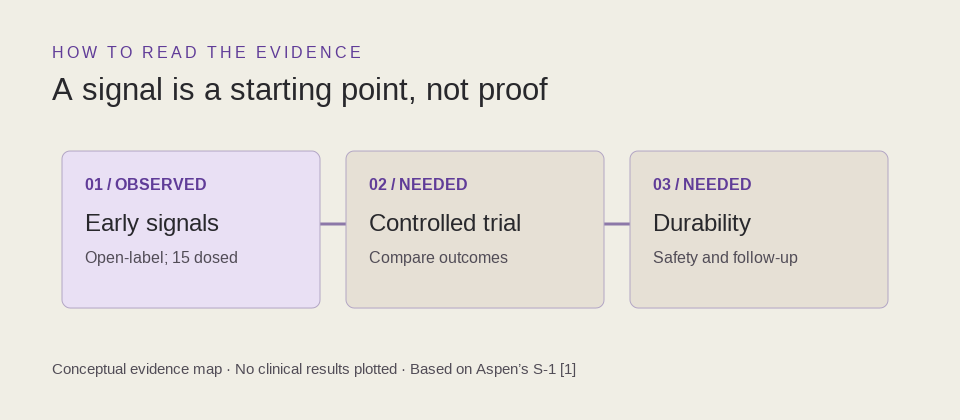
ASPIRO has no placebo or control cohort. Both participants and investigators know treatment was given, and symptoms can change with time, medication adjustments, expectations, measurement and selection. Without a comparison group, changes from baseline cannot confidently be attributed to the graft. Aspen explicitly acknowledges this limitation in the prospectus. Its “clinically meaningful” benchmarks are management-selected comparisons to literature and precedent; the filing says they have not been discussed with FDA or independently validated by third parties. [1]
Imaging observations and motor-score changes are potentially useful signals, but neither alone establishes durable disease modification or the mechanism responsible. Small cohorts and uneven follow-up amplify uncertainty. Regulatory designations mentioned in the filing, including RMAT and Fast Track, are not marketing approvals and do not guarantee an accelerated review or successful outcome. Aspen says a future Phase 3 program is planned; its proposed timing depends on further steps and can change. [1]
A path to the next clinical test
The stated intended uses of IPO proceeds, together with existing resources, include continued ASPIRO work, initiation of a planned Phase 3 Parkinson’s trial, other research and general corporate needs. A larger controlled trial could clarify whether the biological promise translates into meaningful patient benefit. This is a proposed allocation, not evidence those trials will succeed. The company reports $72.4 million of cash, cash equivalents and marketable securities as of June 30, 2026, and says those resources without new financing would not fund the following twelve months under its then-current plan. The filing also says even offering proceeds plus existing funds would not suffice to complete all planned development; additional capital would be required. [1]
Autologous production means a patient-specific manufacturing chain, with associated release testing, timing, variability and cost. Our cell-therapy manufacturing explainer describes why this step can be challenging. Neurosurgical delivery adds its own safety and operational demands. Aspen identifies manufacturing, trial, regulatory and funding risks. None of these risks establishes failure, but the possibility of a successful treatment should not be converted into a prediction of approval or a fair stock price. [1]
What to watch next
The October 30 final prospectus now supplies shares and price, replacing the earlier watch for those terms. Next, distinguish expected delivery from documented completion, and follow controlled clinical results, longer safety follow-up and manufacturing evidence. The historical clinical analysis has not been refreshed from a new trial dataset. This article was reviewed and edited by the site owner on October 14; that is an editorial status, not a verified specialist credential or independent medical review. The October 30 offering update is AI-assisted source checking, not a new expert review. [1,4]
Primary sources
- [1] Aspen Neuroscience, Form S-1 preliminary prospectus ↗
U.S. Securities and Exchange Commission · Filed October 9, 2026 · Accessed October 14, 2026. Offering terms, ASPIRO disclosures, use of proceeds and risks.
- [2] Aspen Neuroscience submissions history ↗
U.S. Securities and Exchange Commission · Accessed October 14, 2026. Public filing chronology; this is a changing record.
- [3] Parkinson’s disease statistics ↗
Parkinson’s Foundation · Accessed October 14, 2026. U.S. and worldwide prevalence, annual U.S. diagnoses; these figures are not a therapy-specific eligible population or sales forecast.
- [4] Aspen final prospectus, Form 424B4
U.S. Securities and Exchange Commission · Dated October 29, filed October 30, 2026 · Opening offering terms accessed October 30, 2026. Shares, price, gross offering amount, approved listing and expected delivery; not proof of trading or settlement.
Owner-reviewed and edited. Not independently medically reviewed. Not medical or investment advice.