- mRNA supplies a protein-making template rather than replacing the cell’s DNA.
- RNA sequence design and delivery chemistry jointly determine whether useful protein is produced.
- A short-lived message can have longer-lived consequences, so transience is not a complete safety assessment.
A medicine can carry instructions instead of protein
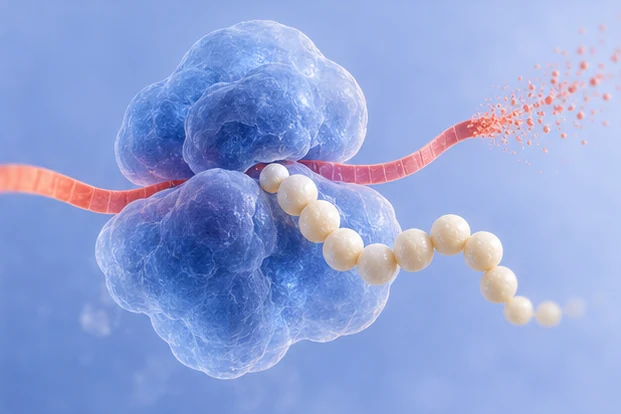
Cells ordinarily use messenger RNA to convey protein-coding information to ribosomes, the machinery that builds proteins. An mRNA medicine supplies a manufactured version of such a message. If the RNA reaches a suitable cell and remains intact, that cell can produce the encoded protein. The administered material is therefore an instruction template, not necessarily the final molecule responsible for the therapeutic effect. [1][2]
This separates mRNA delivery from permanently changing DNA. Ordinary vaccine mRNA acts without entering the nucleus or altering the recipient's DNA. The RNA is eventually broken down, and continued protein production depends on how much usable message remains. That does not mean every mRNA product behaves identically: sequence, formulation, route and the encoded protein all influence the resulting biology. [1][2]
The message contains more than a protein recipe
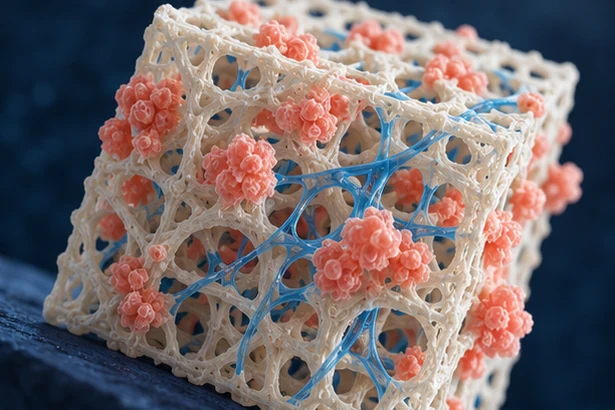
A conventional engineered mRNA includes a protein-coding sequence, untranslated regions, a cap at one end and a poly(A) tail at the other. These features influence recognition by cellular machinery, translation and stability. Two RNAs encoding the same protein can therefore produce different amounts of it or persist differently because their surrounding sequence features are not the same. [2]
Engineering the message is a balance rather than a contest for maximum output. A protein may need to be made at a useful level for a useful interval in particular cells. Excessive or misplaced expression can be undesirable. RNA properties also interact with immune sensing, while the delivery formulation contributes its own effects. The whole product, rather than the coding sequence alone, is the meaningful unit of evaluation.
The delivery package has an active job
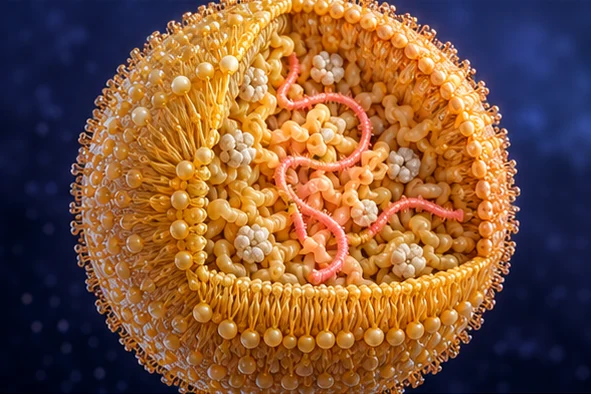
Unprotected RNA does not efficiently cross cell membranes and is vulnerable to degradation. Lipid nanoparticles can protect the message and influence which cells encounter it. Their ingredients may include ionizable lipids, helper phospholipids, cholesterol and lipids bearing polyethylene glycol. Those components affect properties such as particle stability, distribution and interaction with cellular membranes; they are not merely passive packaging. [2]
Even uptake into a cell is insufficient. Material often enters an endosome, a membrane-bound compartment, while translation requires access to the cytoplasm. Ionizable lipids can acquire charge in the acidic endosomal environment and help promote release. Much of delivery engineering concerns improving this transition while maintaining tolerability. Measuring the amount of RNA inside a tissue does not necessarily measure the amount available for productive translation. [2]
A vaccine and a replacement protein pursue different goals
For an mRNA vaccine, the encoded protein serves as an antigen: it gives the immune system a target to learn about. A vaccine can generate an immune response without containing the infectious virus it is designed to protect against. Immune recognition and memory can persist after the original RNA has disappeared, so the duration of the message is not the same as the duration of protection. [1]
Other research applications aim to supply a useful protein, stimulate antitumor immunity or provide molecular machinery for editing. A hypothetical enzyme-replacement strategy might need repeated periods of protein production because the underlying missing function remains. That is a different design problem from vaccination, where durable immune learning may be the objective. Success in one use establishes neither the required dose nor the clinical benefit of another. [2]
Temporary instructions can leave lasting consequences
A transient RNA can encode an editor that makes a lasting DNA change. The RNA and editor protein may later disappear while the altered DNA remains in surviving cells and their descendants. Prime-editing systems illustrate how RNA-directed molecular machinery can establish a new genomic sequence. This is distinct from an ordinary vaccine, whose intended mechanism is antigen production rather than genome editing. [2][3]
The broader lesson is that the lifetime of a drug's physical components is not a complete description of its effects. Immune memory, cell-state changes or an intended DNA edit may outlast delivery. Likewise, calling a message temporary does not prove that every unwanted consequence must be temporary. Safety assessment needs to consider what the message instructs cells to do and what downstream processes it starts.
Read mRNA claims as product-specific evidence
A headline may say that an mRNA candidate produces abundant protein in an animal. That establishes a useful experimental observation, not a completed human treatment. The next questions concern which cells produced the protein, whether it had the expected function, what adverse effects occurred and whether the same delivery and response can be achieved in people. Animal and human results answer different stages of development.
Manufacturing and storage also belong to the evidence chain. The RNA and particles must retain the properties required for delivery and translation, and batches must be consistent. A platform can make it easier to design another candidate without making all candidates interchangeable. The useful claim is specific: this RNA, in this formulation and population, produced this measured benefit with these observed risks. Everything broader remains a proposition to test. [2]
What this does not establish
This article explains conventional linear mRNA medicines and selected research uses; self-amplifying and circular RNA have additional features. Older vaccine and lipid-review sources are used for mechanisms, not their historical lists of authorized products or trial stages. No approval, efficacy or safety claim is made for unnamed protein-replacement or cancer candidates.
Sources & further reading
Source records for this public draft are listed below with their historical access dates. Source checking is not medical validation or completed human editorial review.
- What are mRNA vaccines and how do they work? ↗
MedlinePlus Genetics / National Library of Medicine · Accessed 2026-09-11
Transient mRNA, antigen production, immune response and no DNA alteration by vaccine mRNA. Outdated statement limiting approved mRNA vaccines to COVID-19 is explicitly not used.
- Lipid nanoparticles for mRNA delivery ↗
Nature Reviews Materials · Accessed 2026-09-11
Lipid composition, ionizable lipids, tissue targeting, uptake versus endosomal escape, RNA sequence engineering and therapeutic research applications; not current trial status.
- Prime editing: therapeutic advances and mechanistic insights ↗
Gene Therapy · Accessed 2026-09-11
Nickase–reverse-transcriptase mechanism, pegRNA template, sequence scope, variable efficiency, unwanted products and delivery cargo-size constraints.
Educational information only. Not medical or financial advice. Do not change treatment or investment decisions based on this draft.