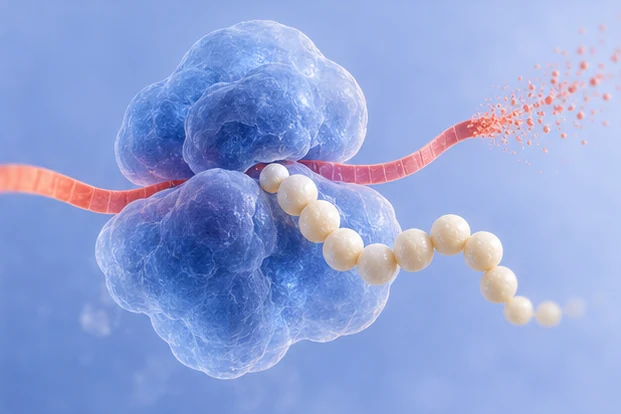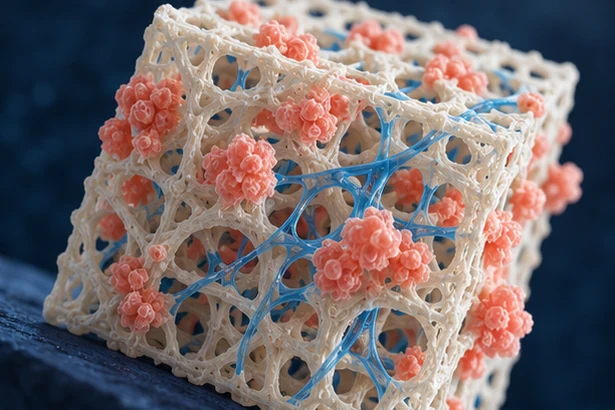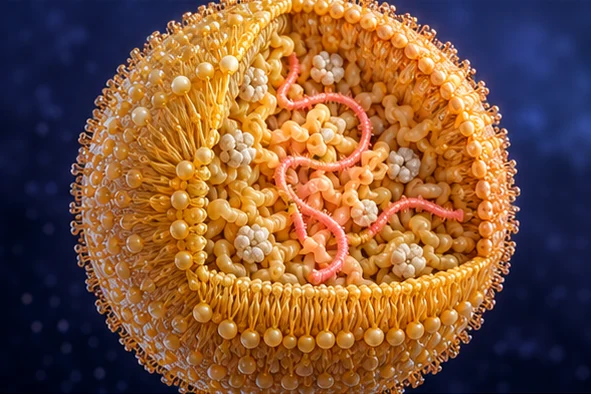
- RNA delivery requires reaching a tissue, entering appropriate cells, escaping an internal compartment, and releasing usable cargo.
- Lipid composition influences biological behavior rather than merely wrapping the active ingredient.
- Uptake, protein expression, and clinical benefit are different measurements.
The sequence needs a route into the cell
Messenger RNA carries instructions that a cell can translate into protein. For an administered mRNA medicine, however, having the correct sequence is only the beginning. RNA is vulnerable to degradation, and its size and chemical properties make crossing cell membranes difficult. A useful delivery system must protect it without trapping it permanently. Lipid nanoparticles, or LNPs, provide one way to negotiate those competing requirements. [1]
Calling an LNP packaging can obscure how active its role is. The particle affects where cargo travels, which cells take it up, whether the cargo reaches the machinery that can use it, and what immune responses are triggered along the way. Two formulations containing the same RNA can therefore produce different biological outcomes. The delivery material and the encoded message need to be evaluated together.
Four ingredients with interacting jobs
Many widely used LNP designs combine an ionizable lipid, helper phospholipids, cholesterol, and a polyethylene glycol-linked lipid, often called a PEG-lipid. These components help organize and stabilize the particle, influence interactions with its surroundings, and support delivery. Their roles overlap: changing a proportion can affect several properties simultaneously. An LNP is not simply a miniature oil droplet with a passive RNA parcel in its center. [2]
Ionizable lipids are particularly important because their charge changes with the chemical environment. They can be relatively neutral under physiological conditions while becoming more positively charged in acidic compartments. That behavior helps reconcile transport outside cells with interactions needed inside them. Particle architecture, lipid chemistry, and relative amounts all matter; knowing the ingredient names alone is not enough to infer a formulation's performance. [1] [2]
Getting inside is not the finish line
Cells commonly take nanoparticles into membrane-bound compartments called endosomes. RNA inside an endosome has entered the cell, but it is still separated from the cytosol, where protein synthesis occurs. The delivery review describes a sequence of barriers: reaching the appropriate organ, cellular uptake, endosomal escape, and release of RNA into the cytosol. Strong performance at one step cannot compensate for complete failure at another. [2]
As endosomes acidify, ionizable lipids can become protonated and interact with lipids in the endosomal membrane. Such interactions can destabilize membrane organization and help cargo escape. This is a mechanistic explanation, not a guarantee that every internalized particle releases its contents. Formulation and cellular context influence the process, and inefficient escape remains an important obstacle. A fluorescent signal inside a cell is therefore not sufficient evidence of productive RNA delivery. [1] [2]
Destination depends on biology as well as design
After administration, particles encounter proteins and biological barriers that can alter their behavior. Proteins associating with a particle's surface can influence recognition and uptake. The route of administration also changes the problem: a formulation delivered into muscle faces a different journey from one introduced into the bloodstream or delivered by inhalation. The reviews discuss tissue targeting as an active area of engineering rather than a solved, universal capability. [1] [2]
Consider a hypothetical formulation that produces abundant reporter protein in an animal's liver. That result would support delivery to at least some liver cells under the tested conditions. It would not show that the same formulation reaches a rare cell population elsewhere, performs equally after another administration route, or benefits humans with a different disease. Tissue accumulation, cell identity, and functional cargo activity must be kept separate in the interpretation.
Safety and stability are design constraints
Immune activity can be helpful when the objective is vaccination, but unwanted when the objective is repeated replacement of a missing protein. Lipid materials and RNA can both contribute to immune responses. The foundational review discusses inflammation, material-dependent toxicity, and possible interactions involving PEG and immune recognition. These concerns are formulation- and context-dependent; they do not establish a single risk profile for all nanoparticle medicines. [1]
Storage is also a biological performance issue. A formulation must preserve useful RNA and particle behavior until administration. The review describes how storage conditions and protective ingredients affect stability. Its historical examples should not be used as current handling instructions for specific products, whose formulations and labels may change. The general lesson is that laboratory activity at the moment of preparation is not enough: the product must remain functional through its intended supply chain. [1]
Measure the whole delivery chain
A strong experiment asks where the particle goes, which cells receive cargo, whether that cargo becomes functional, and whether the intended biological effect follows. Useful controls separate effects of the RNA from effects of the formulation. Studies should also report unintended tissue activity and toxicity, not just the brightest target-organ image. Ultimately, a delivery advance matters because it improves a medicine's benefit-risk balance. A better-looking particle or higher reporter signal is an intermediate result, not the clinical endpoint.
What this does not establish
LNPs vary in composition, structure, cargo, route, and dosing schedule. The cited reviews include preclinical experiments and historical clinical examples; their trial tables and storage details are not treated as current regulatory or handling guidance. Animal targeting results cannot establish human tissue selectivity. This explanation does not rank commercial formulations or imply that success delivering one RNA makes every RNA payload equally safe or effective.
Sources & further reading
Source records for this public draft are listed below with their historical access dates. Source checking is not medical validation or completed human editorial review.
- Lipid nanoparticles for mRNA delivery ↗
Nature Reviews Materials / PubMed Central · Accessed 2026-09-11
RNA protection and delivery barriers, ionizable lipids, administration routes, storage stability, immune responses, and formulation-dependent safety.
- Rational Design of Lipid Nanoparticles: Overcoming Physiological Barriers for Selective Intracellular mRNA Delivery ↗
Current Opinion in Chemical Biology / PubMed Central · Accessed 2026-09-11
Four-stage delivery cascade, common LNP components, protein-corona effects, organ targeting, and ionizable-lipid-mediated endosomal membrane destabilization.
Educational information only. Not medical or financial advice. Do not change treatment or investment decisions based on this draft.