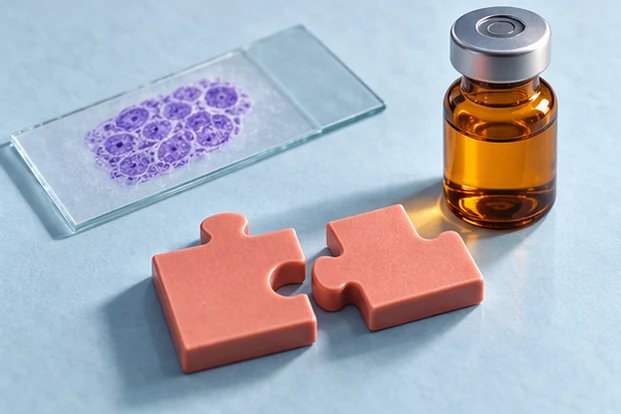
- Liquid biopsy describes a family of tests, not one universal cancer detector.
- A negative result can reflect low shedding or limited assay coverage rather than absence of cancer.
- Detecting a molecular signal and proving that acting on it improves health are separate achievements.
What is actually floating in the tube?
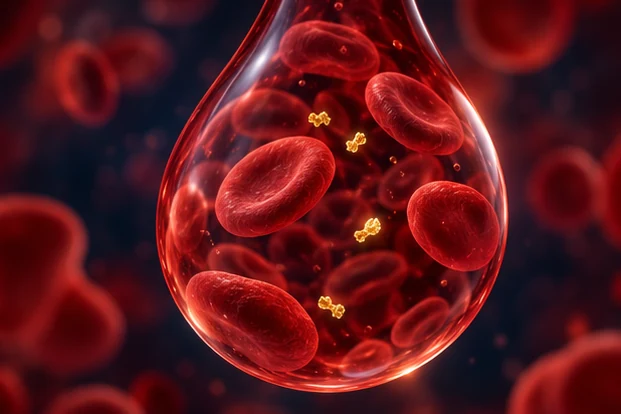
A liquid biopsy analyzes material in a body fluid, often blood, for information about a tumor. Depending on the method, the target may be DNA fragments, RNA, proteins, vesicles, or intact cells. Many prominent tests examine circulating tumor DNA, or ctDNA, released from cancer cells. Most cell-free DNA in blood, however, comes from noncancerous cells, so the assay is searching for a small signal within a much larger background. [1][2]
That distinction matters because liquid biopsy is a collection method and an analytical approach, not a single clinical purpose. A test used to find a treatment-relevant mutation in someone with diagnosed cancer asks a different question from one used to screen an asymptomatic population. A third test may track a known tumor signal after treatment. Evidence for one job does not establish performance for the others.
Biology can impose a limit before sequencing starts
The amount of ctDNA reaching blood depends on tumor size, location, blood supply, and other biological factors. A small tumor or a tumor responding to treatment may release very little material. Blood also clears cell-free DNA. An exceptionally sensitive instrument cannot reliably recover information from tumor fragments that never entered the collected sample. NCI describes this as a biological as well as technical limitation. [1]
In a hypothetical example, two people have tumors with the same actionable mutation, but only one sheds enough DNA into the sampled blood for detection. Different blood-test results would not mean that only one tumor has the mutation. This is why a negative result needs interpretation against the assay’s detection limits, the clinical setting, and the possibility of further tissue or other testing.
A blood sample is not a microscopic tissue section
Tissue examination preserves information about cells and their surroundings that molecular fragments in blood do not reproduce. Blood testing can offer a less invasive way to collect molecular clues and may capture signals from more than one tumor site, but it is not a guaranteed complete census. Different lesions and cell populations can contribute unequal amounts of material. [2]
Discordance between tissue and blood is therefore not automatically proof that one laboratory made a mistake. Samples can come from different places or times, assays can cover different changes, and cancer can evolve. The right comparison asks whether both methods measured the same feature under comparable conditions. Complementary information is often more realistic than a contest to declare one specimen universally superior.
Finding a change does not finish the treatment decision
A detected alteration can help identify a treatment option, but not every alteration is actionable. NCI explains that variants with unknown significance generally do not guide treatment decisions, and a matched therapy may still fail because other tumor features or patient factors affect response. Some cancer cells may carry the target while others do not. [3]
A report should therefore distinguish detection from interpretation. What exact change was found? How strong is the evidence linking it to a treatment in this disease setting? Is the proposed use established, off label, or being studied? These are different questions from whether the assay correctly read a DNA sequence. A molecular match narrows a biological hypothesis; it does not guarantee an individual benefit.
Monitoring requires evidence about what to do next
Repeated blood draws can show whether a tumor-associated signal rises, falls, or becomes detectable again. That can be valuable, especially when repeated tissue biopsies are impractical. But earlier information only helps if a useful action follows. Demonstrating that a signal predicts recurrence is different from showing that starting or changing treatment because of that signal improves outcomes. [2]
Imagine a hypothetical test that detects recurrence months before imaging. Patients could spend more time knowing about recurrent disease without living longer if earlier treatment offers no additional benefit. The finding may still be scientifically important, but clinical utility requires evaluation of the resulting care strategy, including unnecessary treatment, toxicity, anxiety, and outcomes meaningful to patients.
Screening magnifies a different set of uncertainties
In screening, most people tested do not have the target disease. Even a small false-positive rate can therefore generate substantial follow-up, and positive results may require imaging or invasive procedures to locate or confirm a cancer. Screening also risks detecting disease that would not have caused harm during a person’s lifetime. This overdiagnosis is different from a false positive: the abnormality is real, but treating it may not help. [4]
NCI’s account of ctDNA-enhancing methods provides another reminder to read the experimental setting: the reported priming approaches were tested in mice, with human safety and usefulness still requiring investigation. Better detection in an animal experiment is not proof of a safe screening strategy for people. [1]
The right question is therefore not whether liquid biopsies work in the abstract. Ask whether this assay, with this specimen and detection threshold, has been validated for this clinical decision—and whether acting on the result improves the balance of benefit and harm.
What this does not establish
Performance varies with assay, tumor type, stage, treatment timing, specimen handling, and intended use. Historical NCI material is used for biological concepts, not to enumerate today’s approvals or make current product comparisons. No result described here establishes a personal diagnosis or replaces clinical evaluation.
Sources & further reading
Source records for this public draft are listed below with their historical access dates. Source checking is not medical validation or completed human editorial review.
- Increasing ctDNA Volume to Improve Liquid Biopsy Sensitivity ↗
National Cancer Institute · Accessed 2026-09-11
Low ctDNA abundance, normal-cell DNA background, tumor size/location effects, and explicitly preclinical mouse research.
- Liquid Biopsy: Using Tumor DNA in Blood to Aid Cancer Care ↗
National Cancer Institute · Accessed 2026-09-11
Liquid biopsy materials, tissue comparison, heterogeneous shedding, and separation of clinical validity from clinical utility. Historical source used for concepts, not current regulatory status.
- Biomarker Testing for Cancer Treatment ↗
National Cancer Institute · Accessed 2026-09-11
Treatment matching, variants of unknown significance, tumor heterogeneity, changing biomarkers, and limits of testing.
- Cancer Screening Overview (PDQ®)–Health Professional Version ↗
National Cancer Institute · Accessed 2026-09-11
Sensitivity, specificity, predictive values, prevalence, screening harms, overdiagnosis, and randomized evaluation.
Educational information only. Not medical or financial advice. Do not change treatment or investment decisions based on this draft.