Opus Genetics announced on October 16 that FDA approved a supplemental application for phentolamine ophthalmic solution 0.75%, marketed as RYZUMVI, for presbyopia in adults. The October 2026 prescribing information available through DailyMed now lists that indication. This is therefore more than a company-only account of the proposed label, although the FDA approval letter and review memorandum were not separately retrieved. [1] [2]
The most useful question is not whether an eye drop can “reverse aging.” It is what improvement was demonstrated, in whom, at what time after dosing, and with what trade-offs. The label supplies a much narrower—and more informative—answer than a blanket promise to replace reading glasses.
A pupil mechanism, not a gene therapy
Opus also develops retinal gene therapies, but this product is a small-molecule eye drop. The label describes phentolamine as a relatively nonselective alpha-1 and alpha-2 adrenergic antagonist. Blocking receptors on the iris dilator muscle reduces pupil diameter without affecting the ciliary muscle. That distinction matters: changing the pupil is not evidence of repairing the aging lens or restoring its youthful ability to change focus. [1] [2]
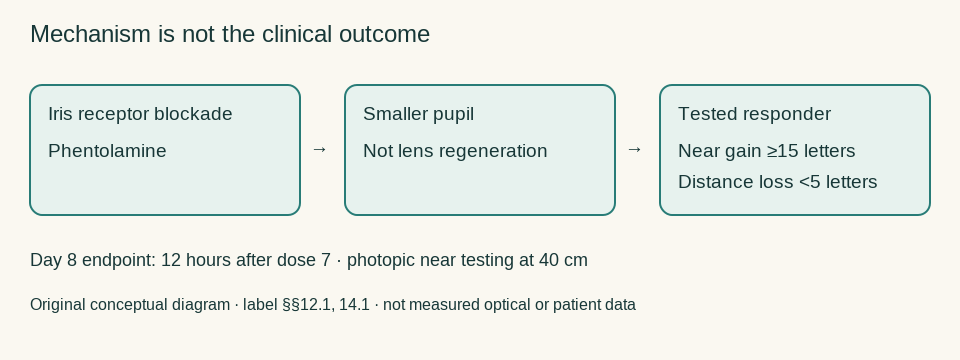
Mechanism alone cannot establish usable reading benefit. That requires controlled clinical measurements. Conversely, a positive clinical endpoint should not be stretched into a claim that every aspect of near vision has normalized.
The exact endpoint contains two conditions
VEGA-2 and VEGA-3 were randomized, double-masked, vehicle-controlled Phase 3 trials. The label describes 902 randomized participants, aged 40–64, with binocular distance-corrected near visual acuity of 20/50 to 20/100 and binocular best-corrected distance acuity of 20/25 or better. Participants received study drops in both eyes once nightly. [2]
The label describes a study-eye endpoint; its table reports percentages of subjects. The Day 8 endpoint assessed a gain of at least 15 near-vision letters at 40 centimeters under photopic conditions, without losing five or more best-corrected distance-vision letters at four meters. Day 8 here means 12 hours after the seventh daily dose—not eight days after a single drop. [2]
That combined definition guards against counting a near-vision gain accompanied by a qualifying distance-vision loss. It does not establish perfect distance vision, reading-glasses independence, or identical performance in dim lighting. It also is a responder threshold, not the average improvement experienced by every participant.
Put the vehicle response beside the treatment response
The following table transcribes the label’s modified-intent-to-treat efficacy population. Absolute differences are original calculations: treatment percentage minus vehicle percentage. They are percentage points, not relative percent improvements. [2]
| Trial and assessment | RYZUMVI | Vehicle | Absolute difference |
|---|---|---|---|
| VEGA-2, Day 1, one hour after dose 1 | 13.5% | 6.1% | 7.4 percentage points |
| VEGA-2, Day 8, 12 hours after dose 7 | 22.6% | 11.0% | 11.6 percentage points |
| VEGA-3, Day 1, one hour after dose 1 | 20.6% | 6.1% | 14.5 percentage points |
| VEGA-3, Day 8, 12 hours after dose 7 | 27.2% | 11.5% | 15.7 percentage points |
VEGA-2 table denominators are 163 treated and 164 vehicle; VEGA-3 denominators are 341 and 228. These total 896, not the 902 randomized participants described in the text. The table explicitly uses an mITT population; the retrieved label does not explain the six-person difference. Do not silently substitute the randomized total as the efficacy denominator or invent the exclusion reasons. [2]
At Day 8 the incremental responder share was roughly 12–16 more responders per 100 participants in the reported mITT analysis, comparing treatment with vehicle, using the rounded reported rates. Most treated participants nevertheless did not reach this stringent composite threshold at that assessment. Failure to meet it is not proof of zero benefit: a smaller improvement could fall below the cutoff. Equally, statistical significance does not mean that most patients achieved the endpoint.
The label reports p<0.01 for Day 8 in both trials. It separately reports a VEGA-2 20-hour result of 24% versus 15% for a three-line near-vision gain. That sentence does not restate the distance-vision condition. It should not be presented as an interchangeable estimate of the table’s composite endpoint or as evidence of continuous glasses-free vision. [2]
Harms and population limits stay in the story
The prescribing information says RYZUMVI was evaluated in 534 subjects in presbyopia trials and reports conjunctival hyperemia in 21% and instillation-site irritation in 16%. These are label-reported treatment adverse-reaction rates, not vehicle-adjusted excess risks: a comparator safety table is not provided in the retrieved section. The company’s statement that no treatment-related serious adverse events were reported does not erase these common tolerability effects. [1] [2]
The label advises against use with active ocular inflammation and includes contamination and contact-lens precautions. This article is evidence analysis, not individualized treatment advice. The label also says the presbyopia clinical studies did not include people aged 65 and over to determine whether their response differs. An adult indication should not be confused with equally direct efficacy evidence at every adult age. [2]
What the approval settles—and what it does not
The October 2026 label, rechecked October 27, explicitly lists adult presbyopia. It does not resolve comparative effectiveness against other drops or glasses, real-world adherence, affordability, uptake, or benefit for an individual patient. Neither source reviewed here establishes those outcomes. [1] [2]
The analytic takeaway is deliberately specific: the trials support an increased probability of a defined near-vision response while meeting a distance-vision constraint at specified assessments. That is a meaningful clinical result without being lens regeneration, a gene-therapy result, or a universal replacement for corrective lenses.
Sources and review limitations
- [1] Opus Genetics, “Opus Genetics Announces FDA Approval of Phentolamine Ophthalmic Solution 0.75% for the Treatment of Presbyopia,” October 16, 2026
Company release read October 27, 2026. Supports the dated announcement, company positioning and attributed serious-adverse-event statement; not independent assessment.
- [2] RYZUMVI prescribing information, revised October 2026, DailyMed / National Library of Medicine
Labeler: Oyster Point Pharma, a Viatris company. Read October 27, 2026, especially sections 1, 2, 5, 6.1, 8.5, 12.1 and 14.1. Supports indication, mechanism, study design, endpoint, mITT table and safety/population limits. DailyMed hosts labeling; it is not an independent comparative study.
Full protocols, participant-level data, the FDA approval letter/review memorandum and independent comparative studies were not retrieved. No confidence intervals or unreported subgroup effects are inferred. Source checking is not independent medical or subject-matter-expert review.
Educational evidence analysis. Not independently medically reviewed. Not medical or investment advice.