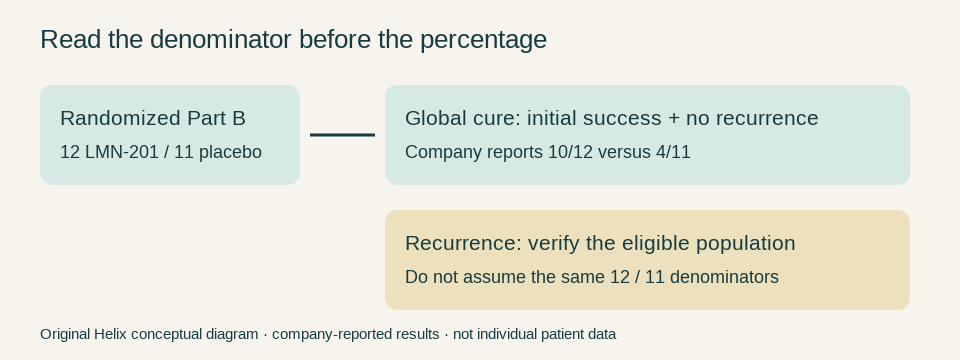
Lumen Bioscience reports a striking global-cure difference for its oral biologic cocktail LMN-201: 10 of 12 participants versus 4 of 11 on placebo in the randomized Part B of RePreve. Both groups received standard-of-care antibiotics. The finding is worth following, but the headline is a 23-person randomized comparison—not a 45-person randomized demonstration and not evidence that antibiotics can be replaced. The company announcement is dated October 21 beneath an October 22 webpage heading. [1]
What the capsule is trying to add
LMN-201 combines three toxin-binding proteins with an antibacterial enzyme, manufactured in engineered spirulina. The registered intervention describes dried, non-viable biomass from four strains: three proteins inhibit toxin B, and a lysozyme-like enzyme targets the bacterial cell wall. This is an investigational oral protein cocktail, not a live microbiota transplant. Its rationale is to address both toxin activity and the organism while patients receive conventional antibiotic treatment. A plausible mechanism explains why to test the product; it does not establish clinical benefit. [1] [2]
Start with the registered outcome
The registry defines global cure as successful initial CDI treatment plus no recurrence during prevention and observation, up to 16 weeks after therapy begins. That composite matters. A patient must first clear the initial episode and then avoid another episode to count as a global cure. A recurrence percentage alone cannot describe the entire treatment pathway. [2]
| Evidence item | What was actually read | Interpretation boundary |
|---|---|---|
| Randomized comparison | Company reports Part B: 12 LMN-201, 11 placebo; double-blinded, stratified by age and antibiotic | This is the denominator for the reported global-cure comparison, not all 45 participants |
| Global cure | 10/12 versus 4/11 | Company-reported outcome; full patient-level accounting not reviewed |
| Recurrence | Company reports 9.1% versus 55.6% | Release does not explicitly enumerate recurrence-analysis denominators; do not silently substitute 12 and 11 |
| Initial cure failure | Company reports a favorable secondary-endpoint trend that was not statistically significant | Composite success does not establish significant improvement in each component |
| Safety | Company says adverse-event rates were similar, with no drug-related serious adverse events or deaths | Small sample cannot exclude uncommon or delayed harms |
| Registered scope | Registry lists Phase 2/Phase 3 and estimated enrollment of 375 | This is not the number analyzed in the announced Part B result |
Sources: company announcement [1] and registry snapshot [2]. The registry is a sponsor-maintained design record, not independent confirmation of the announced outcomes.
Recalculate the headline on the right scale
Using the reported fractions, 10/12 minus 4/11 equals 0.4697: about 47 percentage points. The global-cure risk ratio is approximately 2.29. The corresponding odds ratio is 8.75 using the simple two-by-two counts: (10×7)/(2×4). The company reports an odds ratio of 7.8 and significance under a prespecified Bayesian analysis plan. These quantities should not be conflated. A model-based estimate can differ from the crude odds ratio; the plan and full analysis are needed to explain this particular difference. This analysis does not independently reproduce the Bayesian significance claim. [1]
The small denominator is also visible without a confidence interval: one additional participant changes the observed treatment-arm cure proportion by 8.3 percentage points, or the placebo proportion by 9.1 points. Those are sensitivity illustrations, not alternative trial results. The effect estimate deserves a larger confirmatory dataset rather than the precision implied by repeating decimal percentages.
The reported recurrence percentages differ by 46.5 percentage points and form a ratio of approximately 0.164. But a recurrence analysis may condition on initially cured participants, whereas global cure starts from a broader assigned population. Until the actual denominator, exclusions and missing follow-up are available, those recurrence numbers should remain attributed percentages—not reconstructed patient counts or a guaranteed treatment effect. [1] [2]
What to look for next
The registry snapshot re-read October 27, last posted October 5, lists active-not-recruiting status, estimated enrollment of 375 and an open-label sentinel cohort followed by a blinded main cohort. The announcement describes 45 participants across Parts A and B, with only 23 in Part B. These describe different scopes; neither licenses inflating the randomized result. A full report should reconcile cohort labels, protocol amendments, analysis populations and the registered enrollment target. [1] [2]
The company announcement scheduled a late-breaking IDWeek presentation by Carl Mason for October 24 at 1:30 PM Eastern. That date has now passed. On October 27, targeted searches for the presentation and abstract located the company announcement but did not yield a retrievable conference abstract, slide deck, recording or subsequent full clinical report. We therefore cannot verify whether it was delivered as scheduled or whether additional analyses were disclosed. The announcement still says manuscripts are in preparation. This analysis has not reviewed a conference presentation, clinical manuscript or statistical analysis plan; it does not treat their absence from this search as proof they do not exist. [1]
The important next disclosures are the complete participant flow, exact recurrence denominators, missing-data handling, Bayesian prior and decision rule, antibiotic subgroup balance, follow-up distribution and adverse-event table. The present evidence supports a promising company-reported randomized signal for adjunctive treatment. It does not yet establish routine clinical use, superiority to other preventive products, commercial-scale cost, or regulatory approval.
Sources and review limits
- [1] Lumen Bioscience, RePreve Phase 2 announcement
Webpage October 22; dateline October 21, 2026. Full release re-read October 27. Supports company-reported outcomes, safety statements and scheduled conference details; not independent validation.
- [2] ClinicalTrials.gov, NCT05330182
Complete API record read October 27, 2026; last update posted October 5. Sponsor-maintained design, intervention and endpoint record, not independent confirmation of announced outcomes. No results section was present in the retrieved API record.
Full conference materials, clinical manuscript, patient-level accounting, protocol amendments and the statistical analysis plan were not retrieved. No independent medical or subject-matter-expert review is claimed. Searches conducted October 27 did not resolve exact recurrence denominators or reproduce the Bayesian analysis.
Educational evidence analysis. Not independently medically reviewed. Not medical or investment advice.