An October r/biotech discussion asks how far the benefits of GLP-1-related medicines extend beyond weight loss. The most useful answer is not a list of promising conditions. It is a map of which drug, dose, population and outcome were actually studied. A randomized trial that measures heart attacks is different from one that measures a laboratory marker, and neither establishes a benefit for an unrelated inflammatory condition.
Here are three landmark randomized programs with different clinical questions. Semaglutide is a GLP-1 receptor agonist. Tirzepatide activates both GLP-1 and GIP receptors; it should not be treated as the same molecule or assumed to share every semaglutide result. The studies below used placebo comparisons, but their enrolled groups, doses and endpoints were not identical. [1][2][3]
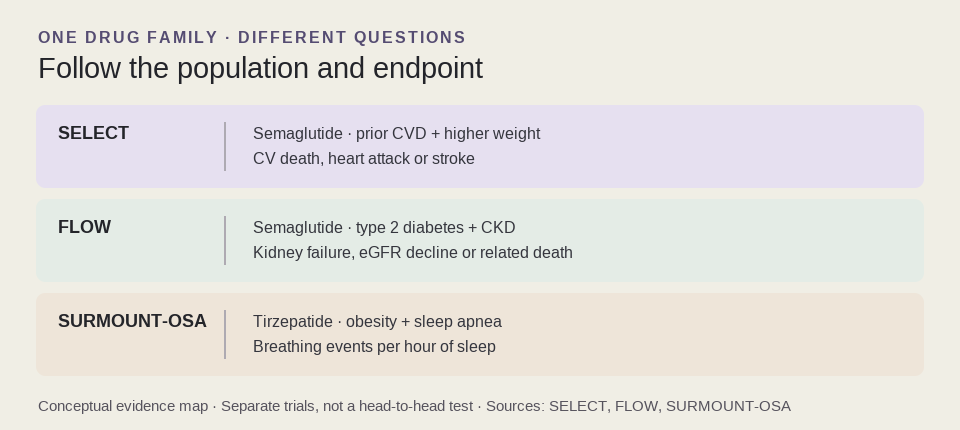
Three questions, three populations
| Trial | Who and what was tested | Primary finding and its boundary |
|---|---|---|
| SELECT | Semaglutide 2.4 mg weekly; 17,604 people with established cardiovascular disease and overweight or obesity, without diabetes | Cardiovascular death, nonfatal heart attack or nonfatal stroke: 569/8,803 (6.5%) versus 701/8,801 (8.0%) with placebo over mean follow-up of 39.8 months. Not a primary-prevention study in everyone who wishes to lose weight. [1] |
| FLOW | Semaglutide 1.0 mg weekly; 3,533 people with type 2 diabetes and chronic kidney disease | First events in a composite of kidney failure, sustained large eGFR decline, or kidney-related or cardiovascular death: 331 versus 410; hazard ratio 0.76. Not evidence of the same effect in people without diabetes and CKD. [2] |
| SURMOUNT-OSA | Tirzepatide 10 or 15 mg weekly for 52 weeks; two trials in adults with obesity and moderate-to-severe obstructive sleep apnea, with or without positive-airway-pressure therapy at baseline | Apnea–hypopnea index fell more than with placebo in both trials. This measures disordered breathing per hour, not a demonstrated reduction in heart attacks or mortality from treating apnea. [3] |
Heart events: relative and absolute effects
In SELECT, the primary composite event rate was 6.5% on semaglutide and 8.0% on placebo: an observed difference of 1.5 percentage points, or 15 fewer first events per 1,000 assigned participants over the trial’s follow-up. The time-to-event hazard ratio was 0.80 (95% CI 0.72–0.90); the 20% relative hazard reduction and the 1.5-point crude event-rate difference answer different questions. Both belong next to the eligibility criteria, not in a universal “GLP-1 prevents heart attacks” slogan. Discontinuation for adverse events was 16.6% versus 8.2%. [1]
The FDA subsequently authorized Wegovy (semaglutide) to reduce cardiovascular death, heart attack and stroke risk in adults with established cardiovascular disease and overweight or obesity, in addition to diet and activity. An indication names a product and population; it is not a class-wide approval. [4]
Kidney outcomes: mind the composite
FLOW assigned adults who had both type 2 diabetes and chronic kidney disease. Its primary endpoint bundled kidney failure, a drop of at least 50% in estimated filtration rate, or death from kidney-related or cardiovascular causes. The hazard ratio was 0.76 (95% CI 0.66–0.88), with 331 versus 410 first events; the investigators also reported a favorable kidney-specific composite. The trial stopped early following a prespecified interim analysis, which makes the stopping context worth noting when weighing precision and longer-term durability. The result is clinically meaningful in its studied population, but “24% lower risk” refers to that particular composite, not a 24% reduction in every form of kidney disease. [2]
The FLOW result supports a defined clinical question in adults with type 2 diabetes and CKD. It does not automatically transfer to another dose, formulation or patient group.
Sleep apnea: another drug, another endpoint
SURMOUNT-OSA ran two tirzepatide trials: one among participants not using positive-airway-pressure therapy at baseline, and one among participants using it. At week 52, mean apnea–hypopnea index (AHI) changed by −25.3 versus −5.3 events per hour in the first trial, and −29.3 versus −5.5 in the second (tirzepatide versus placebo). These are changes from baseline in an apnea measurement, not direct evidence that sleep-apnea treatment reduced cardiovascular events. The FDA approved Zepbound (tirzepatide), with diet and activity, for moderate-to-severe obstructive sleep apnea in adults with obesity; the agency notes that weight loss likely contributes to the AHI improvement. [3][5]
What travels—and what does not
These results cannot establish that GLP-1-related drugs treat psoriasis, restore cartilage, prevent every cancer or benefit every person taking them. Symptom improvements described in a discussion thread may motivate a research question, but anecdotes cannot isolate drug action from weight change, concurrent treatment or chance. Even measured changes in inflammation markers do not by themselves establish fewer clinical events for a new disease. Different drugs, routes, doses, background care and baseline risk matter.
Risks are also part of the evidence map. FDA information for Wegovy and Zepbound lists common gastrointestinal effects and warns about pancreatitis and gallbladder problems. Both carry a boxed warning about thyroid C-cell tumors observed in rodents; whether this occurs in humans is unknown, and the drugs are contraindicated for people with a personal or family history of medullary thyroid carcinoma or MEN 2. This is a discussion of trial evidence, not advice to start, stop or substitute medication. [4][5]
Limitations: The three studies were industry-funded, studied selected populations and measured different endpoints. SELECT’s crude event-rate difference is not an individualized treatment effect; FLOW’s composite includes cardiovascular death; and SURMOUNT-OSA’s AHI is not an all-cause survival outcome. This article reviews selected evidence, not every GLP-1 trial or the latest comparative guideline. Not independently medically reviewed. Not medical or investment advice.
Sources
- [1] Lincoff et al., SELECT trial, New England Journal of Medicine (2023)
Randomized semaglutide cardiovascular-outcome trial; original abstract accessed through Europe PMC, October 18, 2026.
- [2] Perkovic et al., FLOW trial, New England Journal of Medicine (2024)
Randomized semaglutide trial in type 2 diabetes and CKD; original abstract accessed through Europe PMC, October 18, 2026.
- [3] Malhotra et al., SURMOUNT-OSA trials, New England Journal of Medicine (2024)
Two randomized tirzepatide trials in obstructive sleep apnea and obesity; original abstract accessed through Europe PMC, October 18, 2026.
- [4] FDA, Wegovy cardiovascular indication, March 8, 2024
Approved population, efficacy summary and safety warnings; checked October 18, 2026.
- [5] FDA, Zepbound sleep-apnea indication, December 20, 2024
Approved population, trial endpoints and safety warnings; checked October 18, 2026.
Educational information only. Not independently medically reviewed. Not medical or investment advice.