A toxicology package is ready, but the manufacturing package is still being assembled. Should the first wait in a drawer until the second is finished? FDA’s Expedited Investigational New Drug pilot tests a different workflow: bring a scientific partner into development, then review completed components as they become ready. The proposed gain is less idle time between decisions, not permission to start dosing people with an unfinished application. [1] [2]
The application window has closed. On its program page, checked November 12, FDA says it received more than 100 applications from sponsors and prospective Qualified Research Institutions, or QRIs, and anticipates notifying selected participants by December 18. That is an application count, not a count of selected programs or trials begun. The October 30 deadline is past; this is a look at the pilot’s operating rules, not a new invitation to apply. [1]
The clock starts later than the name suggests
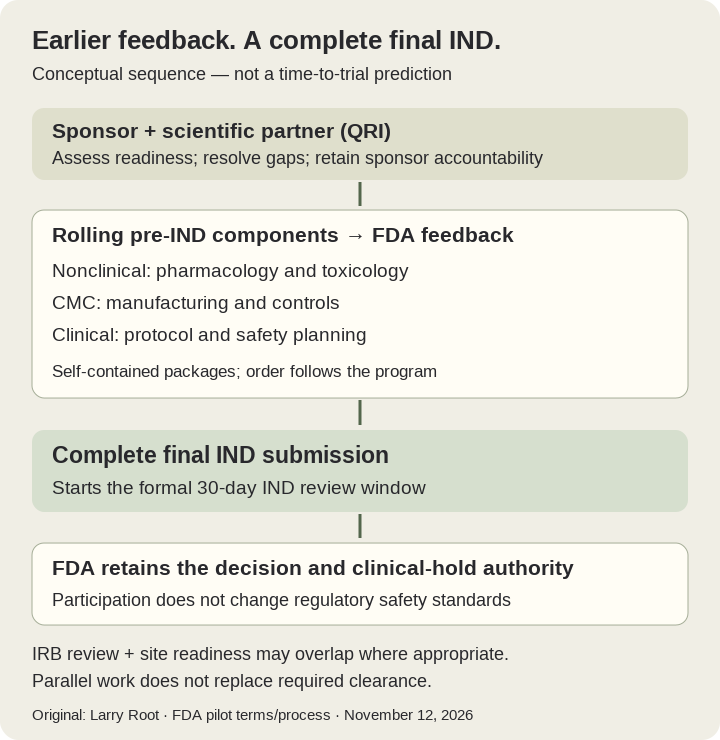
Most of the pilot takes place before the final IND submission. Sponsors submit discipline-specific components to their pre-IND file, with a proposed rolling-submission timeline. FDA does not prescribe one universal order: the development program and QRI guidance determine the sequence. Each component should be a discrete, self-contained package with clear questions—not a stream of fragmentary data. [2]
The distinction matters because the formal 30-day IND review window starts with the complete final IND submission, not with the first rolling component. Once the components are complete and prior feedback incorporated, the sponsor submits the final IND. Outstanding components may go directly into that final submission if routing every remaining item through pre-IND review would delay it. FDA and the sponsor are not being asked to run the same review clock repeatedly. [2]
What a useful early review looks like
Consider a hypothetical sponsor whose nonclinical package raises a starting-dose question while manufacturing work continues. The QRI would assess whether the package has a scientifically sound rationale and data, identify changes needed to avoid a clinical hold, and distinguish those from opportunities to strengthen the submission. A self-contained component could then reach FDA before the entire application is ready. This example illustrates the process; it is not a reported pilot case or evidence that a particular dose would be accepted. [2]
That earlier conversation could expose a consequential gap before a team builds later plans around it. It cannot make the gap disappear. FDA says sponsors retain responsibility for their submissions, including completeness of the final package. Sponsors and QRIs should perform a final comprehensive evaluation for completion and conformance with applicable standards. The agency retains authority over whether an investigation may proceed and whether to impose a clinical hold. [1] [2]
Trial-startup work offers another possible source of saved time. FDA encourages coordination of IRB review and site readiness alongside IND development and review where appropriate. Parallel preparation is not a declaration that all prerequisites have been satisfied, and an IND safe-to-proceed determination is not marketing approval or proof of clinical benefit.
A partner, not a substitute regulator
The QRI label is broader than a university. FDA describes possible participants including academic medical centers, health networks, contract research organizations and regulatory advisors. Its prioritization criteria favor a U.S.-organized entity with a principal U.S. place of business and U.S.-located core advisory personnel, offering support across nonclinical, CMC and clinical disciplines. A sponsor need not itself be U.S.-based. Each application names one designated QRI, which may supplement its capabilities with outside experts while retaining primary responsibility for coordinating support and judging submission readiness. [1]
The pilot primarily targets novel commercial first-in-human Phase 1 programs for trials in the United States, without established clinical experience for the investigational product. New formulations, delivery systems, routes of administration and 505(b)(2) programs are not its primary focus. FDA frames these as prioritization and selection considerations, not an assurance that every apparently eligible applicant will get a place. Support for a novel platform is limited to the technology as incorporated into the specific IND—not a blanket endorsement of the platform. [1]
The relationship also creates a governance question: can a paid development partner give objective advice about readiness? FDA expects written conflict-of-interest procedures and says a sponsor–QRI pair will be removed if conflicts compromise objective recommendations. If the QRI also operates the reviewing IRB, written procedures must separate IRB membership and roles from the pilot advisory process; invited specialist advisers may not vote with the IRB. Scientific expertise does not eliminate the need for that separation. [1]
What would count as success?
The sensible outcome is not simply a shorter final review. Much of the intended improvement happens before that review starts: better phase-appropriate submissions, earlier resolution of problems, fewer avoidable holds or information requests, and less waiting for site preparation. FDA plans to gather written and verbal feedback from IND-initiating activities through first-in-human trial initiation, including what the QRI actually did. [1] [2]
For a useful evaluation, we would want elapsed time from comparable starting points, the work still outstanding at entry, the frequency and reasons for holds, and the resources spent by sponsors, QRIs and FDA. Otherwise, selecting unusually ready programs could look like a faster process. Those are our suggested evaluation questions, not a claim that FDA has published those comparisons or committed to that exact study design.
For now, the agency’s pages describe a model and an applicant pool, not demonstrated time savings or safer trial outcomes. The most interesting bet is organizational: move scientific disagreement earlier, when a team can still change its plan. Whether that produces a durable advantage remains a question for the pilot’s results.
Scope and review: AI-assisted policy analysis based on FDA’s public program terms, FAQs and rolling-submission structure, read November 12, 2026. No independent medical, legal or subject-matter-expert review; no participant interviews or independent performance data. Anticipated selection dates may change. Not medical, legal or investment advice.
Sources
- FDA. FDA Expedited Investigational New Drug (IND) Pilot Program. Full public program text, selection considerations, conflict-of-interest requirements, application-status notice and FAQs read November 12, 2026. Supports stated policy and current application status, not measured pilot outcomes.
- FDA. Expedited IND Rolling Submission Process and Program Structure. Full page read November 12, 2026. Supports component sequencing, sponsor accountability, final IND review-window timing and planned evaluation. No guaranteed review duration or time-saving estimate inferred.