Alpha Tau says the FDA has approved an investigational-device supplement allowing its recurrent brain-tumor study to expand from 10 to 20 patients. The October 19 announcement is a concrete development-program update, not a demonstration that the treatment extends survival and not permission to market it for recurrent glioblastoma. Its most useful implication is the opportunity to collect a broader safety and feasibility dataset. The most important caveat is that the public registry has not yet caught up with the announced changes. [1] [2]
What changed—and which source says so
The company describes REGAIN as a prospective, open-label, single-arm, multicenter trial. The ClinicalTrials.gov record also describes that basic design, but it is sponsor-submitted information, not an independent clinical assessment. As retrieved October 29, its last posted update is July 21, 2026, and it still describes an estimated 10 participants, with no posted results. The registered primary outcomes are successful source placement and acute grade 3 or greater unanticipated adverse events, both assessed from day 0 to 12 months. These are defined measurements, not observed success rates. The table therefore distinguishes the older public protocol record from the newly announced supplement rather than silently replacing one with the other. [1] [2]
| Feature | Registry retrieved October 29 | October 19 company announcement | Interpretation |
|---|---|---|---|
| Enrollment | Estimated 10 | Up to 20 | Larger permitted cohort, not 20 already treated |
| Main objectives | Placement feasibility and safety | Feasibility and safety remain central | More observations do not convert the design into an efficacy trial with a control arm |
| Population | Histologically confirmed WHO grade IV glioblastoma in eligibility text | Also opens to IDH-mutant grade 4 tumors | Broader biology requires transparent subgroup reporting |
| Additional assessments | Local control, pseudo-progression and overall survival among secondary measures | Adds progression-free survival and regular quality-of-life assessments | New measurement opportunities, not positive results |
| Interim timing | No matching new interim description verified | Additional analysis six months after the fifth patient’s July 2026 treatment | Future analysis; do not imply a completed readout |
The announcement says three U.S. academic cancer centers are authorized; the older registry lists Honor Health, NYU Langone and Ohio State. This agreement on sites does not verify that every institution has implemented the supplement. The FDA decision letter and amended full protocol were not obtained for this analysis. The expansion and new endpoint details remain attributed to Alpha Tau. [1] [2]
Why “approval” needs its object
FDA’s investigational-device framework governs permission to conduct device research. Its guidance explains that significant-risk device investigations require both FDA and institutional review board approval. That is a different decision from establishing a device’s market authorization. This analysis does not independently classify REGAIN’s regulatory risk category; the guidance supplies context, not a trial-specific decision letter. [3]
Alpha Tau’s own release explicitly says Alpha DaRT is not approved for commercialization or for recurrent-glioblastoma treatment outside an approved clinical trial. The accurate shorthand is therefore “approval to expand the study,” not “FDA-approved brain-cancer therapy.” The company’s suggestion that the expanded dataset may support future market-submission requirements is a development expectation, not a regulator’s commitment. [1]
What the device is trying to do
The company describes Alpha DaRT as intratumoral sources carrying radium-224. Radioactive daughter products disperse from those sources and emit alpha particles. The intended advantage is localized tumor irradiation with limited exposure of surrounding tissue. For intracranial use, the announcement describes stereotactic, image-guided placement through burr-hole access. These are mechanism and delivery claims, not proof of healthy-brain sparing or clinical benefit in this population. [1] [2]
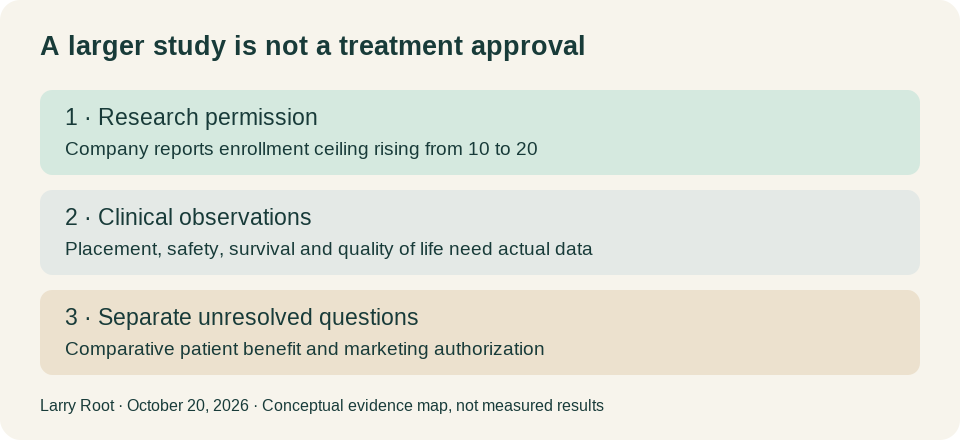
What doubling the ceiling can—and cannot—buy
A larger cohort can reveal additional placement problems or adverse events and describe a wider range of patient experiences. It cannot, by itself, separate a treatment effect from patient selection or subsequent care. REGAIN has no randomized comparator in the retrieved record or announced design. Twenty remains the enrollment ceiling, not a confirmed analysis denominator. [1] [2]
The broader population adds another interpretive burden. The announcement specifically distinguishes IDH-mutant grade 4 tumors from glioblastoma under the modern classification it cites. A pooled survival curve should therefore be accompanied by the actual enrolled diagnoses, prior treatments and subgroup denominators. That is an editorial reporting recommendation, not a verified requirement of the amended protocol. Without those details, a changing case mix could be mistaken for a changing treatment effect.
Progression-free survival, overall survival and quality of life also answer different questions. An imaging-based progression measure is not interchangeable with how long patients live or how they function. The older protocol’s explicit pseudo-progression endpoint underscores why scan interpretation deserves attention. For future reporting, assessment timing, progression criteria, missing questionnaires and reasons for dropout will matter alongside any headline result. No new numerical benefit estimate is established by this protocol announcement. [1] [2]
The next evidence checkpoint is still ahead
Alpha Tau says its REGAIN safety-interim abstract is scheduled for November 13, 7:30–9:30 p.m. Eastern, at the Society for Neuro-Oncology meeting. SNO’s own meeting page confirms November 12–15 in Philadelphia, but the linked interactive program yielded no readable session or abstract text in our October 29 retrieval. The trial-specific slot and promise of new data therefore remain company-attributed, not independently verified from the conference program. The presentation is still future. We have not reviewed its results, follow-up or adverse-event table. [1] [4]
The practical watchlist is an updated registry, the amended protocol or supplement documentation if publicly available, and the actual conference evidence. Read those against a fixed checklist: treated and evaluable denominators, tumor categories, follow-up duration, placement success, severe events, imaging adjudication and patient-reported outcomes. The expansion is news because it changes what researchers may learn next—not because it settles what patients can expect today.
Sources and review limits
- [1] Alpha Tau, October 19, 2026 announcement
Full release re-read October 29: company-announced supplement, delivery mechanism and planned presentation; no regulator decision letter obtained.
- [2] ClinicalTrials.gov, NCT06910306
Complete API record re-read October 29; last posted update July 21, 2026. Sponsor-maintained design and endpoints, estimated enrollment 10; no posted results.
- [3] FDA, IDE Approval Process
General investigational-device framework read October 29; not the trial-specific FDA decision.
- [4] SNO, 31st Annual Meeting & Education Day
Official meeting dates/location read October 29. Linked interactive program returned no readable abstract/session text; trial-specific slot remains company-attributed.
This is analysis of a company announcement, a lagging sponsor-submitted registry and general FDA guidance. The FDA decision letter, complete amended protocol and SNO results were not obtained. Registry absence of new fields does not establish that the announcement is wrong. No independent medical or subject-matter-expert review is claimed.
Educational evidence analysis. Not independently medically reviewed. Not medical or investment advice.